


The Winter Olympics are massively popular in Canada, possibly even more so than the Summer Olympics (which are arguably more popular in other countries). During the 2010 Vancouver Winter Olympics, an estimated 98.3% of the population watched some part of an event on TV.
Which sports drive this popularity? I was curious to find out what the most popular Winter Olympic sports were in Canada. To come up with a ranking of the top five, I looked at the following figures for the 2018 and 2022 Olympic Games.
- TV viewership: which sports had the single most-watched event during the Olympics?
- Interest in following: which sports did Canadians say they were most interested in or intended to follow closely?
- Google search trends: which sports did Canadians search for most during the Olympics?
2022 Winter Olympics most popular sports in Canada by viewership
| Sport | Most watched event | Number of viewers | % of people interested in following* | Google search interest (1-100)** |
|---|---|---|---|---|
| Hockey | Women’s gold hockey medal game, Canada vs. US | 2.7 million | 33% | 56 |
| Freestyle skiing | Women’s Big Air final | 1.839 million | 12% | 0*** |
| Figure skating | Pairs event | 1.81 million | 24% | 6 |
| Curling | Men’s curling, Canada vs. US | 1.81 million | 12% | 19 |
| Snowboarding | Women’s Halfpipe qualifying round | 1.754 million | 15% | 2 |
Notes
*From Ipsos survey of adults 18-74 asking which three events they were most interested in following.
**Between the start and end of the Olympic Games, February 4-20, 2022. Interest is measured on a relative scale of 0-100 for the sport name, e.g. “figure skating”, where 100 means peak search interest within that time period.
***Insufficient data for the search term “freestyle skiing”.
2018 Winter Olympics most popular sports in Canada by viewership
| Sport | Most watched event | Number of viewers | % of people interested in following* | Google search interest (1-100)** |
|---|---|---|---|---|
| Figure skating | Ice dance free skate | 5.7 million | 19% | 6 |
| Curling | Women’s gold hockey medal game, Canada vs. US | 4.8 million | 46% | 41 |
| Snowboarding | Tie between men’s Slopestyle gold medal event and men’s Big Air gold medal event | 3.7 million | 6% | 2 |
| Curling | Women’s curling, Canada vs. Korea | 2.8 million | 5% | 13 |
Notes
*From an Ipsos survey asking Canadians which sport they would follow most closely.
**Between the start and end of the Olympic Games, February 9-25, 2018. Interest is measured on a relative scale of 0-100 for the sport name, e.g. “figure skating”, where 100 means peak search interest.
#1: Hockey: the most popular sport during Olympics and year-round
Hockey consistently pulls in the most or some of the most TV viewers for a single event (men’s or women’s hockey) for every Winter Olympics. In the Sochi Winter Olympics in 2014, around 15 million people — almost half the population — watched some part of the men’s hockey gold medal game.
Viewer numbers dropped in the 2018 and 2022 Olympics, but they still stayed at the top of the ratings charts. Incidentally, 2014 was the last time NHL players participated in the Olympics, so their return in the Milano Cortina 2026 Games will almost certainly pull in record numbers again.
The viewership numbers are backed up by Canadians’ self-reported interest in or intent to watch an Olympic hockey game. In 2018, 46% of people surveyed by Ipsos said they planned to follow hockey closely at the Winter Olympics, the highest for any sport.
For the 2022 Beijing Olympics, a global survey by Ipsos found that hockey was the sport most Canadians were interested in, with 33% saying they would put it in their top three Olympic sports to follow.
Google search trends for the term “hockey” during the 2018 and 2022 Olympics also far outstripped the popularity of searches for other Olympic sports.
Unsurprisingly, hockey’s popularity endures outside of the Olympics. According to Vividata’s SCC Sports 2025 study, hockey has 16.5 million fans, exceeding the fan base numbers for any other Canadian professional league.
#2: Figure skating: the crowd pleaser
In 2018, the most-watched Olympic event in Canada was Tessa Virtue and Scott Moir’s ice dance free skate performance, with 5.7 million viewers. The next most watched event was the gold medal women’s hockey game between the US and Canada, which had 4.8 million viewers.
In fact, if we look at Canadians’ top five most watched events of the 2018 Olympics, three out of five were figure skating events with 4 million viewers or more, for a total of 13.8 million.
So why didn’t I rank figure skating the most popular winter Olympics sport?
Because while it pulls in more casual viewers for marquee events, there is more sustained interest in hockey. In 2014 and 2022, TV viewership for a single event in hockey outnumbered viewership for any other sport.
A look at Canadian searches trending on Google during the actual dates when the 2018 and 2022 Olympics took place shows that interest in “hockey” was six to nine times higher on average than for “figure skating”. Interest peaked on February 17, 2022 relative to the rest of the Olympic Games period during the women’s gold hockey game, which Canada won.
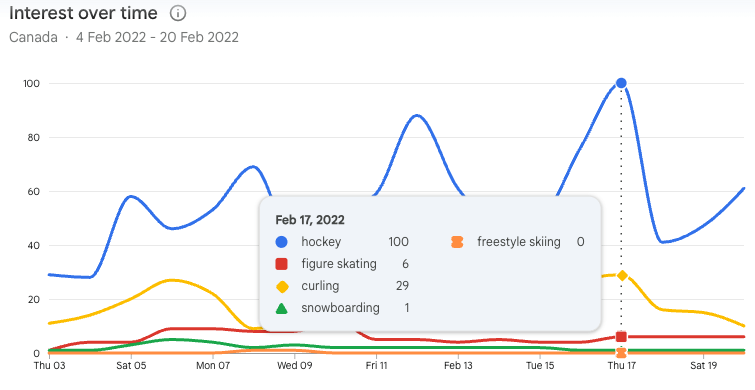
Source: Google Trends
The gold medal factor has a significant pull on viewership, which is why a figure skating event in 2018 had higher TV ratings than the women’s gold medal hockey game.
In 2018, Virtue and Moir were already buzzed-about record-setters, and winning gold in 2018 made them the most decorated figure skaters in Olympic history. The 5.7 million viewers were tallied as they stood on the podium as Olympic champions, meaning that a lot of people were tuning in to bask in the triumph rather than necessarily having watched the event itself.
This accounts for why figure skating had the single most watched event in 2018, but the proportion of people indicating an interest in following the sport was less than half that of those who intended to follow hockey (46% vs. 19%).
Olympic hockey is for the die-hards and figure skating for the casual fans. Since figure skating’s popularity depends more on gold medal potential and less on a deliberated intent to follow, it sits firmly in second place.
#3. Snowboarding: the social media darling
Snowboarding takes a solid third place for most popular Winter Olympic sport. In 2018, two separate events, men’s Slopestyle and men’s Big Air tied for third-highest TV viewership with 3.7 million viewers each. For both the 2018 and 2022 Olympics, it came third as the sport that most people intended to follow.
In terms of search trends, snowboarding didn’t elicit as much interest on Google compared to hockey, figure skating, or curling. That’s more an indicator of how audiences prefer to consume snowboarding content than it is of its popularity.
Hockey is best watched on a big screen with a group of buddies. Figure skating can be switched on as casual background viewing. But the high-octane visual spectacle of snowboarding means that it’s best suited to highlight reels on social media.
CBC Sports TikTok followers more than doubled during the 2022 Olympic Games and video views went up more than 160% compared to the Tokyo 2020 Olympics. This reflects the increasing shift from live television viewing to non-live highlights or replays for snowboarding and skiing sports.
A 2025 study from the International Ski & Snowboard Federation showed that snowboarding saw the biggest growth in viewership. A lot of that was driven by audiences viewing it on non-live media, a number 10 times greater than audiences viewing on live TV.
Which explains why Canadians weren’t searching for snowboarding on search engines; they were swiping through and sharing reels on their social media feeds instead. Snowboarding has always been one of Canada’s strongest sports, and its popularity will probably continue to measurably increase as more people turn to digital media to watch it.
#4: Curling: a Canadian cornerstone
For a game that has a pace closer to chess than to a competitive physical sport, curling is massively popular amongst Olympic audiences. In 2018 it had the fourth-highest number of viewers of a single event within any sport, and in 2022, it tied with a figure skating event for the third-highest number of viewers.
Canadians’ intent to follow curling during the 2018 and 2022 Olympics indicates a steady level of pre-existing fan interest. Though lower than the interest in hockey, figure skating, and snowboarding in both years, it’s shown a jump between the two Olympic Games from 5% to 12% (the numbers aren’t correlated with a precise increase since the survey methodology differed).
This is also reflected in the increased search interest in Google Trends for “curling” when comparing the 2018 and 2022 Olympics.
In fact, even though it had a smaller audience than snowboarding in 2018 and a smaller audience than freestyle skiing sports in 2022, the volume of relative search interest for curling was higher than for both other sports. Because Canadians love curling, and not just at the elite sports level.
Unlike sports like figure skating, which reach peak awareness during capstone events like the Olympics, curling has a year-round following. The national men’s curling championship, the Montana Brier, has an average audience reach of 6.5 million over ten days.
It’s also a popular community sport. Canada has around 1,000 curling clubs across the country, more than any other country in the world. While not quite as iconically Canadian as hockey, curling is a unique part of the cultural identity — a significant factor in its unique popularity in Canada.
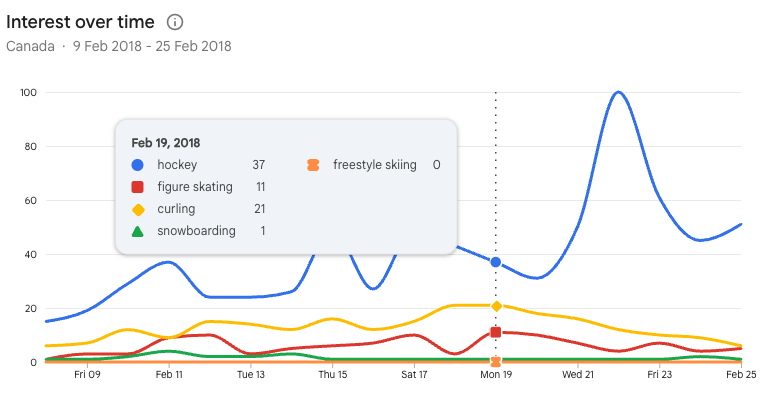
At its peak during the 2018 Olympics, interest in “curling” was higher than for figure skating, snowboarding, and freestyle skiing. Source: Google Trends.
#5. Freestyle skiing: the star spectator sport
Freestyle skiing was the surprise runner-up in 2022 in terms of Canadian viewership numbers: 1.839 million, second only to the women’s gold medal hockey game. Freestyle skiing didn’t even figure in the top four events in viewership numbers in 2018.
In the 2022 Olympics though, there were four individual events in freestyle skiing which broke the 1 million+ viewers threshold. For comparison, there were six snowboarding events surpassing one million viewers.
This suggests that the popularity of freestyle skiing is rising, though it’s not yet at the same level as snowboarding. (Freestyle skiing rivalled curling as one of the top sports Canadians were interested in following in 2022, but still sat below snowboarding.)
Freestyle skiing’s popularity can be attributed to star power and historical dominance. In terms of Olympic medals, freestyle skiing is Canada’s third-most successful sport with 30 medals in total. In recent Games, prodigies like moguls skier Mikaël Kingsbury and halfpipe skier Cassie Sharpe have repeatedly put Canada on the podium.
But Canadians aren’t only watching the sport for their own stars. In the 2022 Beijing Olympics, 18-year old Chinese-American Eileen Gu, a freestyle skier, Stanford physics student, and model became the youngest multi-gold medallist in freestyle skiing, turning her into a sports sensation. Over 1.6 million Canadians watched her gold medal halfpipe run in Beijing.
Freestyle skiing doesn’t have widespread tribal appeal like hockey. There are only about 80 freestyle skiing clubs in Canada, compared with over 2,500 hockey associations. Instead, freestyle skiing’s intense, high-adrenaline performances draw people in primarily as a spectator sport. The more recognizable faces there are to cheer for, the more Canada will be watching.
Milano Cortina 2026 Olympics
Canadians’ most popular Winter Olympic sports are also the sports which Canada will most likely win medals in. Check out my gold medal predictions for the upcoming Milano Cortina 2026 Winter Olympics and get the details on the best events to watch and how.
Sources
- https://www.cbc.ca/sports/olympics/winter/cbc-radio-canada-beijing-olympics-ratings-1.6360361
- https://mediacentre.cbc.ca/announcement/3830/canadians-are-up-with-cbc-radio-canada-as-coverage-of-pyeongchang-2018-reaches-more-than-80-per-cent-of-the-population-over-the-first-10-days-of-competition/
- https://mediacentre.cbc.ca/announcement/4927/7-in-10-canadians-tune-in-for-beijing-2022-audiences-spent-more-time-with-cbc-during-beijing-2022-than-any-other-network-in-canada-with-digital-viewing-surpassing-pyeongchang-2018/
- https://www.ipsos.com/sites/default/files/ct/news/documents/2018-02/winter_olympics_factum_feb_9_2018.pdf
- https://www.ipsos.com/sites/default/files/ct/news/documents/2022-02/Global-Public-Attitudes-Beijing-Winter-Olympics-2022.pdf
- https://www.thesportsexaminer.com/skiing-snowboard-just-how-many-people-watch-fis-world-cups-reports-show-a-cumulative-5-82-billion-viewers-in-2024-25/