

For a long while, sweepstakes casinos in the US have avoided being tarred with the brush of illegal gambling thanks to an ingenious dual-currency loophole. Such sites typically use a free, virtual currency system for standard play, while also allowing players to purchase a separate currency if they wish to.
If that sounds like an unnecessary complication, think again. This distinction allowed sweeps operators to claim that they’re selling entertainment, rather than gambling. In other words, they had a free run to operate without a license even in US states where online gambling is prohibited.
But finally the tide has turned. The past months have seen anti-gambling lobbyists, state regulators, and licensed casinos join forces to address the legal loophole that allowed sweepstakes sites to generate over $10 billion in 2025. What was previously considered a legal gray area has now been formally defined as illegal gambling and banned in at least nine states, with more bans looming on the horizon.
And there’s more bad news in store for the operators of unlicensed sweeps casinos. Players who have been bitten by the sweepstakes bug are now being encouraged on Classaction.org to fight back with a class action suit that could see them recover the money they lost with damages on top.
The Legality of sweeps in the US
The legal reasoning behind the sweepstakes debacle may not be immediately obvious to casual players. The similarity between the games offered on a typical sweeps site and those offered by regular online casinos is very obvious. Yet, these unregulated sites were allowed to operate with impunity both in states where online gambling remains illegal and in those where it requires a license. This raises the question: why were sweepstakes not legally treated as online gambling from the get-go?
To understand the subtle distinction, we’ll need to delve further into the history of these platforms and how the dual-currency system that sweepstakes casinos employ emerged. Sweepstakes casinos started out as so-called social casinos that offered players the opportunity to play casino-like games such as slots and blackjack without wagering real money. There was no exchange of money, no cashing out, and no real prizes, placing the model squarely and unequivocally outside of the scope of gambling regulations.
Eventually, the models evolved to include “freemium” gameplay. Players could still enjoy all games for free, but they could also purchase virtual currencies to extend their gameplay. This finally led to the birth of sweepstakes casinos, a hybrid platform that allows players to experience both free-to-play games and sweepstakes promotions with real prizes. While no purchase is necessary to play, those who wish to can now buy coins and play for actual cash prizes. And herein, according to a KPMG report, lies the issue: the free games and the sweeps inhabit the same environment, with players able to easily switch between the two.
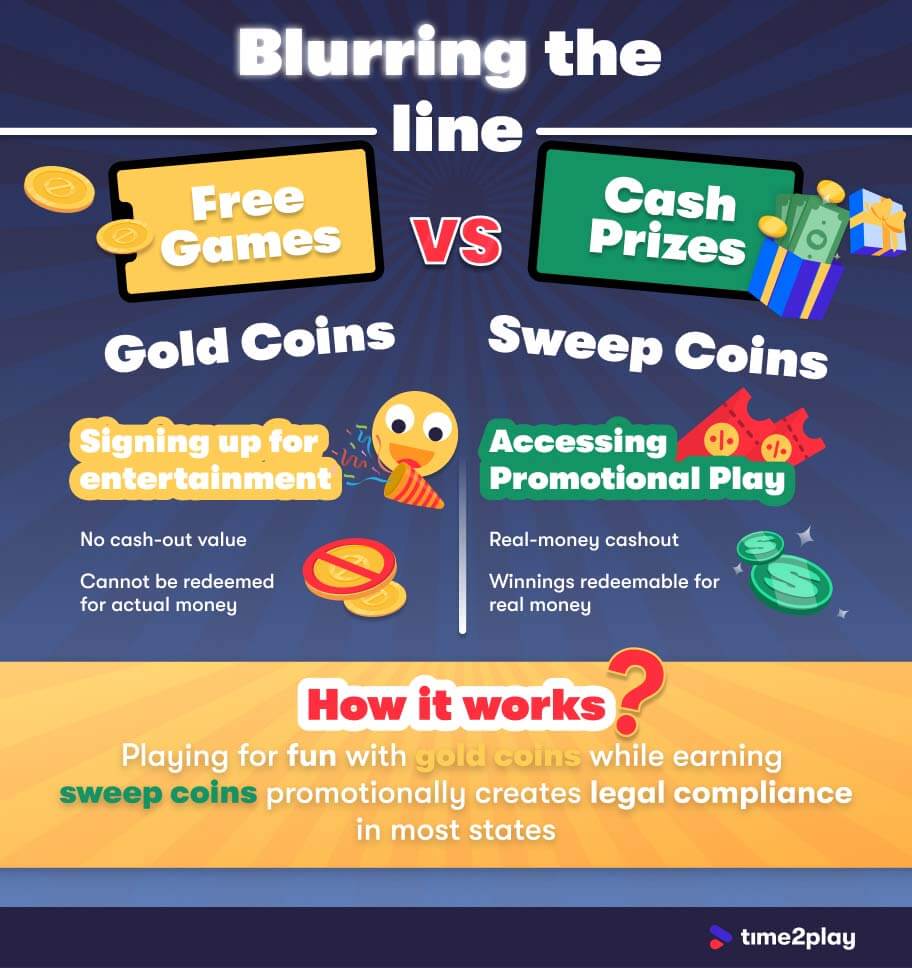
Thus, the line between free games and those with cash prizes becomes blurred. Here’s exactly how it works:
- Upon signing up to a sweepstakes casino, you are typically given an amount of coins in virtual currency to play the games for entertainment. These are usually referred to as Gold Coins (GC) or similar, and they have no cash-out value. In other words, you cannot redeem them for actual money. You can top up your Gold Coins through site promotions such as login rewards, or by buying additional coin packages.
- You will also receive a separate virtual currency, usually called Sweeps Coins (SC) or something similar. Unlike GC, SC can actually be cashed out as real winnings. SC are never sold, but are generally given out through daily log-ins, bonus codes, social media updates, free tournaments, or even by requesting them through email.
The fact that you can exchange your SC for real American dollars is the crux of the matter here. As soon as you reach the minimum amount of SC required for cashing out, the process is entirely similar to the one you’d follow to withdraw your winnings at a regular casino.
However, operators argued that this model did not constitute online gambling, because the sites are structured as sweepstakes promotions. You buy your GC for entertainment, and you’re offered SC as a free bonus with no purchase necessary. It may take a few legal convolutions, but the conclusion is that you’re not actually paying directly for the chance to win money. Thus, no gambling is taking place.
Sweepstakes casinos like Stake.us and Chumba take very good care to draw attention to this legal nicety, incorporating the disclaimer within their terms and conditions: “The platform and games do not offer real money gambling, and no actual money is required to play.”
Yet, regulators and lobbyists were not fooled, at least not for long. Ryan Beallis, writing in the UNLV Gaming Law Journal, puts his objections unequivocally: “Looking deeper, these platforms seemingly offer nothing more than an easily accessible form of unregulated gambling,” he states, adding that if current legislation does not cover their regulation, then states need to legislate for a more precise definition of gambling.
Regulators appear to see the value in Beallis’ words. The legal approach has now shifted to analyze the practical reality of what sweepstakes casinos are doing, rather than going by the formal wording of the law. The main question many state regulators are asking is one: does paying for the virtual currency grant access to playing games with cash prizes? If the answer is yes, the current favored view is that players aren’t simply buying entertainment. They’re putting money into a system tied to prize-linked play, which is the very essence of gambling.
California
Down in the Golden State it all started with Assembly Bill 831, which introduced a targeted ban on online sweepstakes that use “a dual-currency model with a similar environment to online gambling”. On September 12, 2025, the State Assembly unanimously passed the bill with a vote of 63-0, but the law had been in the works for a long time.
Assemblymember Avelino Valencia, who introduced the bill, argued that the state couldn’t “look the other way while these platforms exploit legal gray areas”. His view was supported by the vice chairman of the Yuhaaviatam Tribal Council of San Manuel Johnny Hernandez, Jr., who lauded the bill for closing “dangerous loopholes” and strengthening “the integrity of California’s gaming system.”
California lawmakers likewise believed that operators were exploiting “No Purchase Necessary” language to sidestep the state’s regulations vis-à-vis gambling. Governor Gavin Newsom signed AB 831 on October 11, 2025, and the law took effect on January 1, 2026.
New York
In March 2025, New York put forward two companion bills, A6745 in the Assembly and S5935 in the Senate. Both shared the same core policy: to prohibit online sweepstake games.
On June 13, S5935A passed the Senate and was adopted by the Assembly, banning all online sweepstakes games and support services around them. It also prescribed fines between $10,000 and $100,000 to be collected by the Gaming Commission and deposited into the commercial gaming revenue fund for problem gambling education and treatment. The law expressly bans the dual-currency system, while giving the state regulator the power to determine what constitutes this.
Action was taken swiftly. That same month, the attorney general’s office issued a press statement describing how it had targeted 26 “online platforms offering players slots, table games, and sports betting using virtual coins that could be exchanged for cash and prizes.” The platforms received a cease-and-desist letter demanding that they stop all prohibited activity and giving them a time limit by which they needed to confirm that they had stopped operations. This effectively resulted in them being chased out of the state.
New Jersey
In August 2025, bill A5447 became law, its remit clearly laid out in the official summary: to prohibit sweepstakes model of wagering; establish new penalties for unlawful gambling operations and practices; and directing the Division of Consumer Affairs and Division of Gaming Enforcement to enforce such penalties.
The move may have come as a surprise to sweeps operators, considering that New Jersey is one of the most gambling-friendly states and one of the first three states to legalize online gambling. Yet, the anti-sweepstakes bill was granted unanimous support by the Assembly, with fines of up to $100,000 for a first offense and $250,000 for subsequent offenses imposed.
Despite the objections of the Social and Promotional Games Association, which argued that the move was happening too fast, Governor Phil Murphy signed with no hesitation.

New Jersey negotiating for sweepstakes casinos to take a gambling license
There’s a possible plot twist on the horizon, according to Penn Live. Since then, Senator Joseph P. Cryan has introduced another bill to allow sweepstakes casinos to operate under New Jersey’s regular online gambling laws. If it passes, Senate Bill 1500 would make it possible for sweepstakes casinos to apply for a gambling license in accordance with regulations and pay taxes on profits.
Which state will ban sweeps casinos next?
The clean sweep, if you’ll pardon the pun, is not over and done with yet, as several other states have either already presented bills to the Senate or the Assembly, or else are actively planning to do so.
While it’s impossible to predict precisely which will be the next state to ban sweeps casinos, some already appear to be in a relatively advanced stage of discussions. Others, like Maryland, are placing the issue on the back burner for now. The below are the states to keep a close eye on.
Indiana
The Indiana Gaming Commission (IGC) has already made its position clear on its official website: online sweepstakes casinos “have been ruled by Indiana and federal courts to be illegal gambling.” Now, the state is codifying its position into legislation through House Bill 1052, which was signed by Governor Braun in March 2026.
The new law specifically targets dual-currency casinos and empowers the IGC to impose a penalty of $100,000 against anyone conducting a sweepstakes game in Indiana, or anyone involved in such a transaction with a person located in Indiana. It also classifies this as a Level 6 felony.
The full ban will now be enforced as of July 2026.
Tennessee
Tennessee is following in the footsteps of the other states that have instituted a total ban on sweepstakes casinos. In December 2025, Attorney General Jonathan Skrmetti announced that his office had stopped multiple operators from continuing with their services in the Volunteer State. Almost 40 casinos, including Chumba and Fortune Coins, were targeted with cease-and-desist letters, with Skrmetti saying: “They work hard to make these sweepstakes casinos look legitimate, but at the end of the day they are not.”
Meanwhile, the law in Tennessee is soon set to follow suit with SB 2136, which received unanimous support by the Senate and has been approved by the legislature. It is now awaiting formal enrollment before being presented to Governor Bill Lee for signing. The bill explicitly targets sweeps casinos and dual-currency models, including virtual coins and tokens that are received for free with the purchase of another currency. If Governor Lee signs the bill, the ban will be effective immediately.
Louisiana
The road for Louisiana has not been as straightforward as that of some other states. The first attempt to ban sweepstakes casinos was presented through SB181, which sought to amend Louisiana’s gambling-by-computer statute, by providing definitions of sweeps gaming, prohibiting the practice and laying down penalties.
However, Governor Jeff Landry vetoed it on the grounds that the bill attempted to criminalize internet gambling activities that were already prohibited in Louisiana. Had it made it through, the law would have seen penalties of up to $100,000 and imprisonment for up to five years being dished out to offenders.
This is not to be read as tacit approval of sweeps. House Bill 53 is currently being debated; the new proposal takes a different approach by defining sweepstakes operations as “racketeering.” Moreover, the Louisiana Attorney General Liz Murrill in 2025 issued a formal legal opinion declaring that online businesses offering casino-style games which use virtual or dual-currency redeemable for cash or prizes, are operating as illegal gambling businesses and are subject to criminal and civil enforcement actions.
Minnesota
Minnesota has kicked off the process leading to a formal ban via SF4474, which is bluntly described as “an online sweepstakes games prohibition law.” Sweepstakes are defined as games that use a dual-currency system that allows the player to redeem the currency for cash or a prize, or offers the chance to win real prizes.
The bill goes beyond targeting operators, and places liability on any party facilitating the process, such as financial institutions, payment processors, geolocation providers, gaming content suppliers, and media affiliates.
While the bill is expected to make it into law by end of year, the authorities have already made it clear that sweeps casinos are considered to be illegal gambling operators.
2026 Sweepstakes casino ban tracker
Here are all the states where it is either not allowed or in the process of being banned to play at sweepstakes casinos, in chronological order, from newest to oldest changes.
| State | 2026 action type | Status and comments |
|---|---|---|
| Oklahoma | Statutory Ban (SB 1589) | Enacted May 2026. State legislature successfully voted to override governor’s veto, putting the online casino and dual-currency ban into effect. Ban to come into effect November 1st, 2026 |
| Tennessee | Statutory Ban (SB 2136) | Enacted May 2026. Passed conference deal and signed by governor. Uses Consumer Protection Act to prosecute sites. Strict reinforcements will come into action August 1st, 2026 |
| Iowa | Regulatory Action (SF 2289) | Enacted May 19, 2026. Effective July 1, 2026. Grants the state gaming commission explicit power to issue cease-and-desist orders. |
| Maryland | Regulatory Crackdown | Ongoing: SB 652 (formal ban) failed in April 2026, but the MLGCA continues to issue 90+ cease-and-desist orders under existing law. |
| Maine | Statutory Ban (LD 2007) | Signed April 6, 2026. Effective July 14, 2026. Explicitly outlaws dual-currency models; fines up to $100k. |
| Illinois | Regulatory Action | Ongoing: AG issued dozens of cease-and-desist letters in March 2026. Several operators exited. |
| Louisiana | Pending Law (HB 53) | In Progress: Passed House and Senate in spring 2026; expands state racketeering laws to target online sweepstakes operators. |
| Indiana | Statutory Ban (HB 1052) | Signed March 13, 2026. Effective July 1, 2026. Prohibits multi-currency platforms; civil penalties of $100k per violation. |
| Mississippi | Pending Law (SB 2104) | Failed: Bill passed Senate in February but died in House committee on March 3, 2026. State remains in a legal gray area. |
| Virginia | Pending Law (SB 579) | Delayed: Continued to 2027 session in Feb 2026; however, AG warnings remain active for operators. |
| California | Statutory Ban (AB 831) | Enacted: Became active Jan 1, 2026. $25,000 fines per violation; major operators have already geofenced the state. |
| New York | Statutory Ban (S 5935A) | Enacted: Effective late 2025/early 2026. Civil penalties up to $100k; major sites (e.g., VGW) have exited. |
| Nevada | Statutory Ban (SB 256) | Enacted: Effective Oct 1, 2025. Protects local retail properties by criminalizing web sweeps. |
| Montana | Statutory Ban (SB 555) | Enacted: Effective Oct 1, 2025. Completely outlaws virtual casino properties using sweeps cash. |
| Connecticut | Statutory Ban (SB 1235) | Enacted: Effective Oct 1, 2025. Prohibits unlicensed simulated games utilizing dual-currency parameters. |
| New Jersey | Statutory Ban (A 5447) | Enacted: Effective Aug 15, 2025. Protects state real-money iGaming by prohibiting sweeps equivalents. |
| Michigan | Regulatory Action | Banned: The gaming control board utilizes aggressive agency notices to block operators, beginning with major sweeps operators in late 2023. |
| Delaware | Regulatory Action | Restricted: Initial regulatory cease-and-desists date back to February 2023, forcing major operators (like VGW) into total market exits. |
| Washington | Statutory Prohibition | Banned: Long-standing law RCW 9.46.240 lists un-licensed online chance play as a felony. |
| Idaho | Constitutional Prohibition | Banned: Long-standing state constitutional ban on lotteries outlaws online sweeps. |
The infrastructure blackout, or how to make it impossible for sweeps casinos to keep operating
You may argue that it’s all very well and good for US states to ban sweeps casinos, but how can this ban be enforced in practice? Most operators are registered offshore, which in theory makes enforcement complicated. Even if they’re found to be in violation of the law, can any consequences be realistically applied?
Turns out, yes. The states that have implemented sweeps bans, or that are planning to, all have one thing in common.
Complete ban over the infrastructure
The state legislation doesn’t only target the operators themselves; it also integrates vendor liability, rendering the entire infrastructure that supports these platforms illegal. All ancillary services from payment processing to game providers, geolocation providers, app stores, cloud hosting, and even influencers, streamers and brand ambassadors are covered by the ban.
States like California and Minnesota have expressly embedded this provision in their new legislation. Anyone providing services for the illegal hosting of sweeps casinos is subject to the same consequences as the operators themselves. Zwillgen.com reports how service providers will also be liable to huge fines and possible criminal proceedings as laid down in the anti-sweeps law.
This has led to a flurry of state exits from service providers, some of which have been on the receiving end of lawsuits and cease-and-desist letters. In August 2025, Los Angeles State Attorney Hydee Feldstein Soto filed a suit against Stake.us and the gaming providers that made their titles available through the platform: Pragmatic Play, Evolution, Big Time Gaming, Red Tiger, NetEnt, No Limit City, and Hacksaw Gaming.
And it doesn’t stop with the penalties expressly laid down in the anti-sweeps legislation. States are also taking the tax implications into consideration. In September 2025, WOW Vegas and VGW were sued to the tune of $44.4 million by the Louisiana Department of Revenue.
The message is clear: there is no tolerance for violations of the new anti-sweeps laws. Some platforms are taking these provisions more seriously than others. High 5 Casino, for instance, contracted a geolocation provider to ensure that the platform is in compliance with individual state requirements. The solution verifies each player’s actual location in a bid to avoid being liable for any location fraud attempted by subscribers.
State enforcement of the sweeps ban legislation has been pretty consistent. Gambling Insider reports how in Louisiana, West Virginia, Tennessee, Delaware, and Maryland, attorneys general have led the battle with cease-and-desist orders. The move led to a mass withdrawal of over 120 operators from these states.
Is Card Crush the next hybrid model for sweepstakes casinos?
With many anti-sweepstakes laws specifically targeting the dual-currency model, it’s starting to look like it’s the end of the road for sweeps casinos in many states. Except that we’re already seeing an evolution in platform trends, with more complex models emerging in a bid to stay one step ahead of the law.
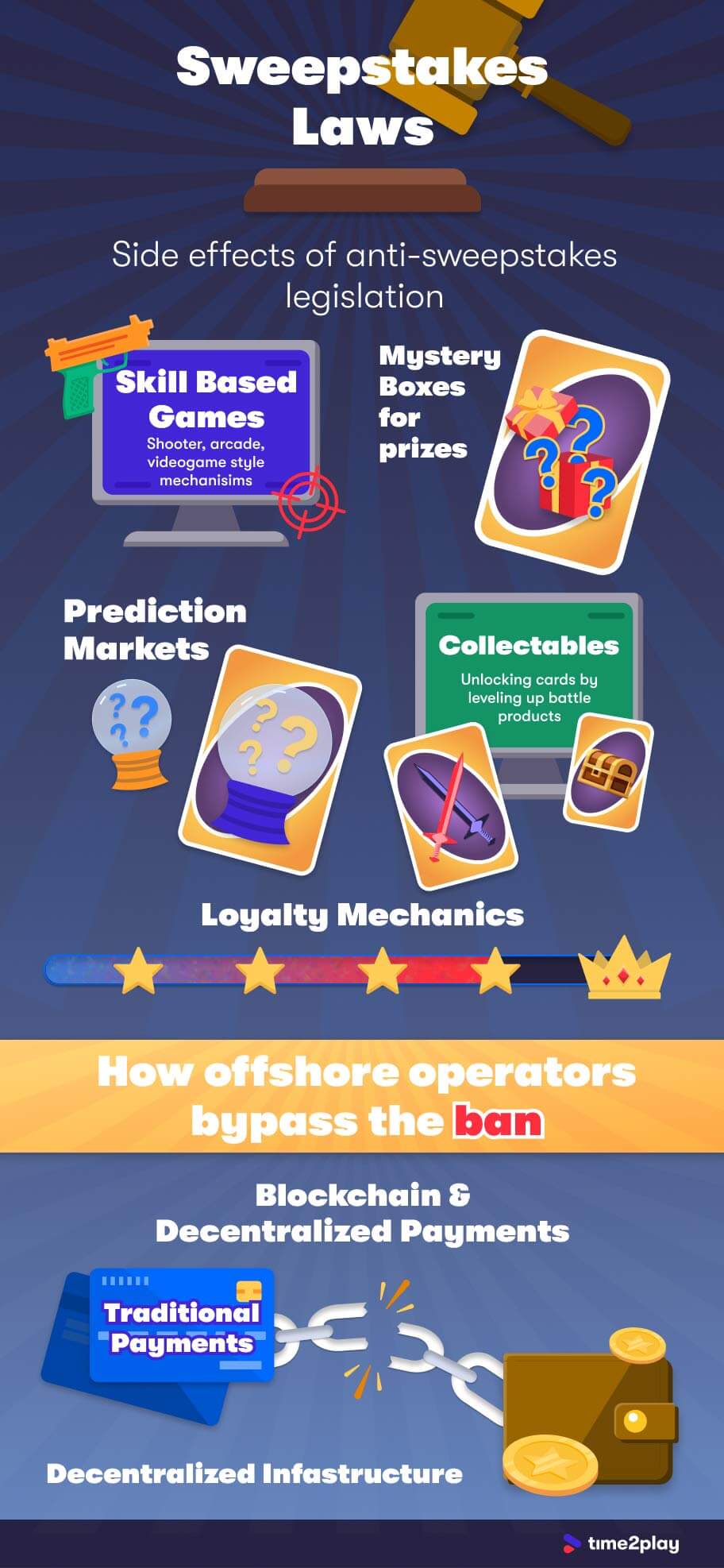
These new models don’t present a straightforward Gold Coin and Sweeps Coin currency offer. Instead, they combine skill-coded gameplay, collectibles, loyalty mechanics, casino-style games, and alternative payment structures. Whether they will succeed in avoiding the ban hinges on the legal interpretation of what constitutes a sweepstakes game.
The legal angle being pushed by these operators is that the product is not a prohibited “online sweepstakes game” because the user is not simply buying one virtual currency and receiving another redeemable one.
Sites like Card Crush offer a useful case study. According to its terms of service, the site operates only in California and New York — two states where sweepstakes have been banned. It markets itself as a card collection/battle product, and even the language it uses moves away from the classic casino/sweepstakes model. Terms like unlocking cards, leveling up, and battling all point towards a card game structure. Cards cannot be redeemed for cash or prizes. That said, the site also offers casino-style games like slots, and allows players to redeem Mystery Coins for prizes.
The strategy here appears to be trying to separate the collectible/card layer from the redeemable-value layer, while still offering casino-style games in the background. Whether the ploy will actually work remains to be seen. Law firm Jacobs Counsel believes that, as long as the games are predominantly based on skill, rather than chance, the potential is there.
Overall summary: the legal loophole is closing, but we haven’t necessarily seen the end of sweepstakes yet
The US sweepstakes casino model was built on a technicality. Players were not buying a chance to win money, so the service couldn’t be classified as gambling. Instead, they were purchasing entertainment credits while receiving a separate promotional currency for free.
For years, this argument allowed platforms to operate where licensed online gambling was either tightly controlled or prohibited altogether. That technicality is now closing fast. Regulators are looking at the practical reality of the product. A number of states have explicitly banned these platforms, with more set to follow suit. Those that haven’t issued a formal ban are taking the route of cease-and-desist letters.
In the future, it’s going to be much harder for offshore operators to run sweeps casinos unhindered in the US. That said, it’s unlikely that the model will disappear altogether. Some operators will leave hostile states; others may pursue licensing where a regulated route becomes available. Others still will test new hybrid models built around skill gaming, collectible mechanics, arcade-style gameplay, prediction markets, or decentralised payments.
From a player perspective, it’s important to be knowledgeable about the law of the state you’re playing in, while bearing in mind that changes are happening quickly. Equally important, players who lost money may now have legal recovery options, including mass arbitration or class action alternatives.
The sweepstakes casino boom was born of legal ambiguity, and the next chapter will probably also be shaped by how much ambiguity regulators are still willing to tolerate. Right now, the answer from a growing number of states appears to be: very little.
Research methodology
This report is based on a state-by-state analysis of how US lawmakers, regulators, attorneys general, courts, and industry stakeholders are responding to the sweepstakes casino model. The research uses primary legal and regulatory material, including bill texts, official state resources, attorney general statements, cease-and-desist letters, court decisions, and regulator notices. It is further supported by specialist gambling industry reporting and legal analysis.
The focus was on identifying the formal legal position in each state and the enforcement strategy being followed. Each state was assessed according to four main indicators:
- Whether sweepstakes casinos are expressly banned;
- Whether regulators or attorneys general have taken enforcement action;
- Whether pending legislation is likely to change the position;
- Whether the wider infrastructure supporting these platforms, including payment processors, game suppliers, affiliates, geolocation providers, and media partners, is being targeted.
This approach helps distinguish between states where sweepstakes casinos are clearly prohibited, states where the legal risk is rising, and states where the position remains less settled.