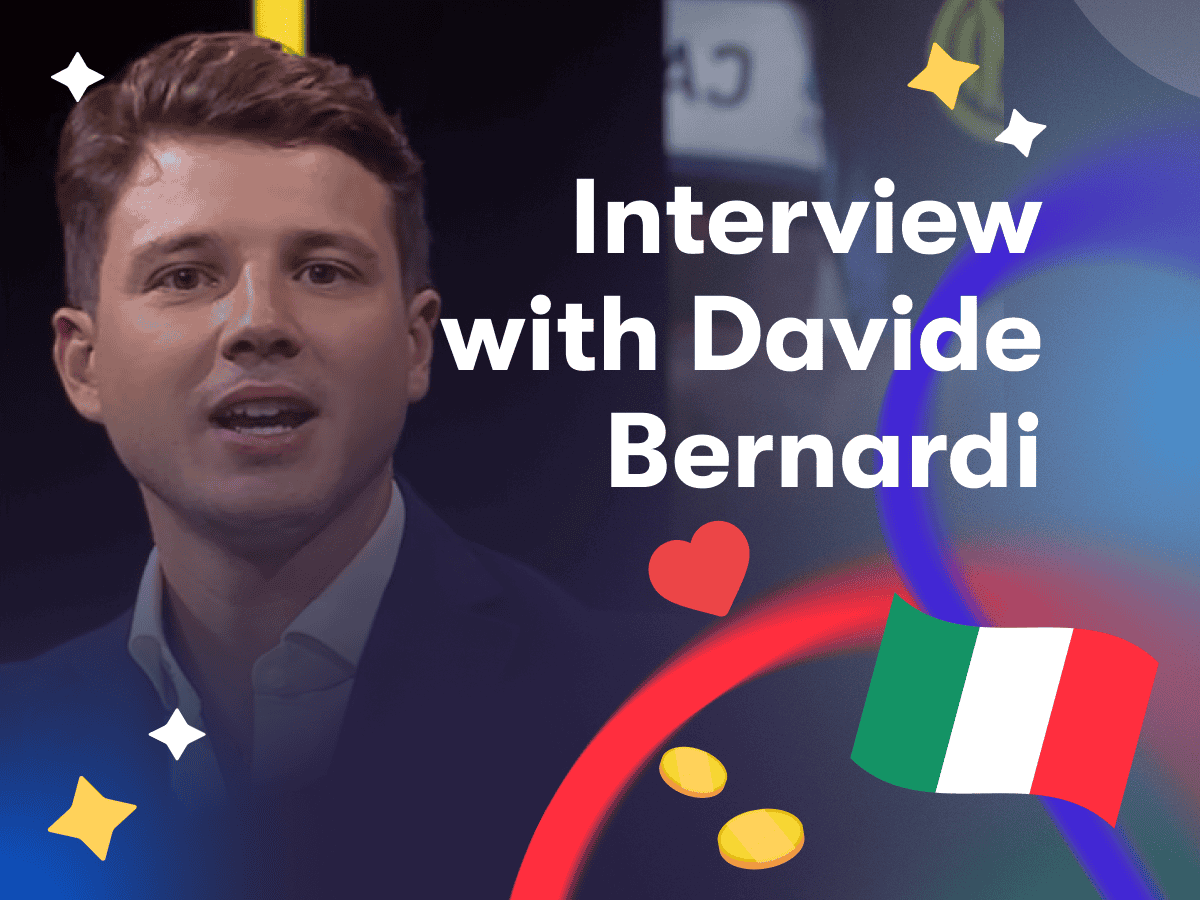


Davide Bernardi is one of the most interesting voices on DAZN Italy, the platform where he hosts BordoCam, his innovative show focused on Serie A. We reached out to him for a chat about soccer, ranging from the current state of our league to the upcoming World Cup in the United States, Mexico, and Canada, as well as the transfer market. This was all while analyzing the most critical issues in the soccer world today. We started with his program on the sports streaming network and his close-up, privileged view of the field.
Davide, can you tell us how the idea for BordoCam was born and what makes the storytelling of matches so powerful in this format?
The idea was born around 2016 while I was working at Fox Sports. While watching a style of storytelling similar to BordoCam in Spain—a program called El Día Después—I thought it could work in Italy as well.
In Spain, this narrative style is very common because many networks broadcast soccer on free-to-air TV. Since they didn’t always have access to as many images as the major Italian broadcasters, they often used a dedicated camera on the sidelines to capture the details and emotions of the match.
Seeing that style of storytelling, I realized it could be a way to shed even more light on an event that the public normally experiences from their couch, focusing only on what is broadcast. You can’t choose the cameras; you can’t catch everything that happens. So I thought: “This could be a different, more immersive way to tell the story of a match.”
How did you manage to put the idea into practice?
We made the first attempt at Fox Sports, thanks also to the vision of Manuele Corazzi and Marco Foroni, during the “Clásico del Bernabéu” featuring Messi’s famous gesture. Then we brought the idea to DAZN Italy when Cristiano Ronaldo arrived at Juve. Initially, we wanted to follow his entire season with a BordoCam dedicated to every match, creating almost a documentary from the field about Cristiano Ronaldo.
For production reasons, that idea didn’t go through, but the project stayed there. Then COVID arrived: with no fans in the stadiums, you could hear everything, and there was a need to produce different types of content. From there, we began developing it more and more, leading up to the definitive explosion with Napoli’s championship title, which made the format much more viral.
BordoCam is a perfect format for going viral, sitting right between sports journalism and social media. Is there still an authentic relationship between journalists and players today? Can you tell us an anecdote?
That’s a good question. The relationship today is very different compared to many years ago. The other day, I saw a reel of an Argentine journalist entering Argentina’s locker room before the Argentina-Australia match at the 1994 World Cup. The players were getting ready, and he walked right up to Batistuta to ask how he planned to attack the Australian defense.
Today, something like that would be unthinkable in Italian soccer. In basketball, for example, in the EuroLeague, you still see pre-game interviews directly on the court, but not in soccer. It’s hard to define the relationship between journalists and players in general terms because there are so many dynamics.
Today there is social media, communication has changed, and many players tend to be more protective. It depends a lot on the person, your role, and the contacts you build over time. If you work often on the sidelines, maybe the players get to know you; if you mostly work from the press box without off-field relationships, it’s harder to create a direct connection.
Let’s talk about Serie A, a tournament you’ve followed closely and which has now delivered almost all its verdicts. What grade do you give this season?
It was a very strange season. Inter won deservedly because they were the team that made the fewest mistakes. However, the fact that they finished with such a large point lead also highlights the limitations of the other teams.
The paradox is that Inter didn’t even shine in the head-to-head matches, yet they managed to maintain a consistency that the others lacked. They were able to find solutions even in difficult moments.
Napoli, on the other hand, had a very unlucky season. As Italian champions, with the moves they made in the market, it was right to consider them favorites at the start of the season. Then they had an enormous amount of problems, and Conte was good at always finding solutions despite the injuries.
Milan, in my opinion, ruined the perception of their season a bit in the final weeks. However, I believe Allegri did a great job. He had a very wide gap to close, with many new players and a complex psychological situation after the lost Coppa Italia final. For a while, they really believed they could fight for the title.
What do you think about the investigations into referees in recent weeks? Have they been handled correctly by the media or too sensationally?
I think it’s impossible to judge without having the full picture. You would need to read all the documents carefully, and it’s risky to give judgments now.
I really liked how Fabregas spoke about the situation in a press conference: he said there are too many variables we don’t know yet, so exposing oneself would be wrong. I totally agree. First, everything needs to be understood clearly; then a serious opinion can be expressed that respects the people involved.
Italy, unfortunately, will not participate in the World Cup, but DAZN Italy will cover the event completely. Will you be part of the team? What do you expect from this tournament?
Yes, we are still defining everything because obviously, it changes quite a bit without Italy. However, it will still be an extraordinary occasion: 104 matches and a World Cup in the United States, Canada, and Mexico.
In my opinion, it will be a particular World Cup. It’s likely the last big opportunity for players like Messi, Modrić, and Cristiano Ronaldo. After this tournament, a new generation will truly open up. I believe DAZN Italy will do everything to tell the story in the best way possible.
Who do you see as the favorite?
It’s hard to give a single answer. Based on talent and how the players are peaking, I think France has a little something extra. However, you also have to watch Spain, who always manage to find incredible cultural and technical resources when it comes to major tournaments.
Then there is the defending champion Argentina and Ancelotti’s Brazil. In the World Cup, you need skill, management, and a bit of luck. And Ancelotti, in his career, has always shown he has both.
How much can this World Cup impact the growth of soccer in the United States?
A lot. MLS is already doing a great job bringing in big players and big brands. Messi isn’t just a soccer player: he is a moving corporation.
In the United States, soccer was already very widespread, especially at the women’s level, but now the men’s movement is also growing a lot. They have important players: McKennie, Pulisic, Weah… and Canada has also grown tremendously. I don’t know how much they will be able to close the gap with Europe, but they have incredible facilities to grow further.
Can playing at home be an advantage for the United States?
Definitely, yes. There will also be the climate issue: at the Club World Cup, for example, the heat and storms were a problem.
I’m curious to see what kind of World Cup it will be. Every World Cup leaves something behind: in 2014, for example, we started to see goalkeepers participate much more in the buildup play. I want to see what the new tactical trend of this edition will be.
And how do you imagine the atmosphere in the stadiums?
The facilities will be extraordinary, huge. However, tickets are very expensive, so it will be interesting to see how many foreign fans will be able to attend.
I was told that for Brazil-Morocco, there were over 12 million ticket requests. I’m curious to see how all this demand will be managed.
Now for a few quick “one-shot” questions. Are you ready?
Go for it.
Messi or Ronaldo: who has done more for soccer
Messi.
Serie A or Premier League: which is harder to analyze?
Premier League.
VAR: the salvation of soccer or a historic mistake?
Salvation.
The funniest player you’ve met?
Florenzi. He made me laugh a lot in person
And the grittiest?
Gattuso. Among those I’ve seen, definitely him. And then Sergio Ramos.
The most surprising coach?
Farioli. I’ve seen him in person and found him truly very good. I think he is undervalued in Italy. Everywhere he has gone, from Ajax to Porto, he has always done a great job.
One word to describe these national teams. Italy?
Disappointed…
Spain?
“Picardia.” That competitive malice and positive arrogance that has made them competitive for generations.
United States?
Mysterious. I’m curious to see what Pochettino will do.
Canada?
Curiosity. Canadian sports are growing so much.
England?
Hope. They have enormous quality but can never manage to win.
Give me a name for the transfer market for some Italian teams. Inter?
Carnesecchi.
Milan?
Sørloth.
Juventus?
Bernardo Silva.
Napoli?
Probably a central midfielder. Napoli doesn’t need to change much if the injury list clears up.
Roma?
A midfielder with tactical geometry and legs, like Guerra from Valencia.