
Interactive Brokers Prediction Markets review 2026: Trade macro event contracts
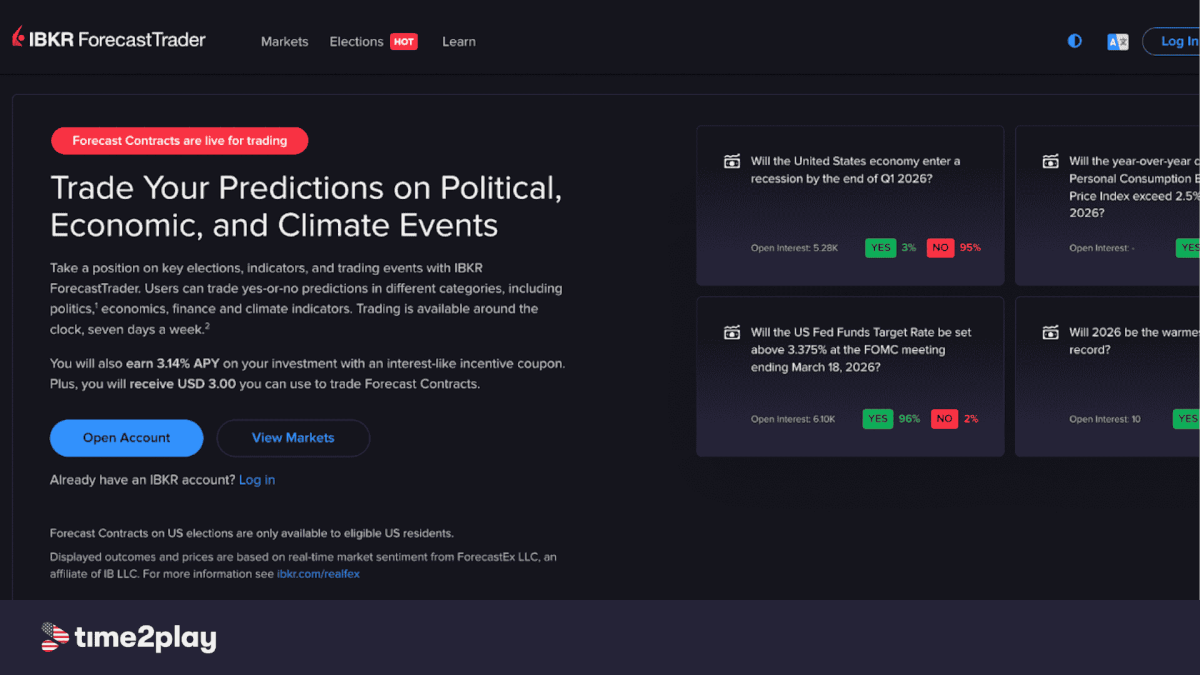
Interactive Brokers lets users trade prediction markets through its ForecastTrader platform. Here, you can buy and sell contracts based on real-world outcomes like economic data, elections, and global events. Instead of making traditional bets, you trade event contracts with prices that show how likely the market thinks an outcome is.
In this review, I’ll cover how Interactive Brokers prediction markets work, what types of markets are available, and whether the platform is worth trying.

Interactive Brokers Prediction Markets key takeaways
Powered by ForecastEx (CFTC-regulated exchange owned by IBKR)
Available in all 50 US states
No minimum deposit requirement
Markets focused on economics, politics, and global macro events
No sports or entertainment prediction markets available
What is Interactive Brokers Prediction Markets, and how does it work
You can access Interactive Brokers Prediction Markets through the Interactive Brokers platform using the ForecastTrader interface.
Contracts on Interactive Brokers trade between $0.02 and $0.99, depending on how likely the market believes the outcome is. If the prediction is correct, the contract settles at $1. If the prediction is incorrect, the contract settles at $0, meaning you lose the amount you spent to buy the position.
Once you buy a contract, you can hold it until the event is settled, or sell it early if the market price changes. If the contract price goes up, selling early lets you take a profit, and if the price falls, you can sell to limit your losses.
Interactive Brokers Prediction Markets are available to Interactive Brokers clients in the United States, Canada, and Hong Kong. However, certain markets, such as US election contracts, are restricted to US residents due to regulatory requirements.
Pros
Fully regulated exchange (CFTC via ForecastEx)
Supports limit orders and full order book trading
No minimum deposit requirement
Integrated into a professional trading platform
Cons
No sports or entertainment markets
The interface is complex for beginners
Limited payment methods (bank-only)
Liquidity is still developing compared to larger exchanges
Interactive Brokers Predition Markets app review
You can use Interactive Brokers Prediction Markets right from the main Interactive Brokers platform with the ForecastTrader interface. Event contract trading is available on the IBKR mobile app for iOS and Android, as well as on the web and desktop Trader Workstation (TWS). Prediction markets are built into the brokerage platform, not a separate app.
The interface mirrors the Interactive Brokers trading environment, and lets you navigate assets like stocks, options, futures, and event contracts within a single system, so prediction markets are included as an additional tradable product.
You can explore events tied to economic data, politics, and global trends. The layout shows more information than simpler apps, including bid/ask prices, market depth, and order types, so this setup is more designed for trading, making it a better fit for experienced users than for beginners.
App rating: 84/100
Finding contracts in the app is not as easy as on simpler platforms like Underdog Predict. Instead of just clicking on a specific event like a game, I had to explore the ForecastTrader section in a bit more detail and sift through different categories.
I found the pricing clear and easy to understand. You can clearly see the contract price, bid/ask spread, and implied probability right away, so you know your potential payout, and the extra data can also be helpful if you know how to use it.
Placing trades is straightforward, but it feels more like using a full trading platform rather than a casual app. You basically choose your order type, set your price if needed, and complete the trade. Once you learn the interface, it’s quick, but not as simple as just tapping through one screen.
Compared to platforms like Kalshi, the experience is similar because both use an exchange-style system. But when you compare it to apps like Underdog or Robinhood, Interactive Brokers feels more like a trading terminal. It gives you more control and data, but the learning curve is steeper, so I rate it a bit lower for ease of use.

Different prediction markets available at Interactive Brokers
Markets here are grouped into around 4 core macro categories, including economics (inflation, interest rates, unemployment), politics (elections and policy outcomes), financial benchmarks, and weather-related events. The exact number in each category changes depending on data releases or global events.
Unlike other prediction platforms, Interactive Brokers doesn’t offer contracts for games, tournaments, or entertainment. Its market catalog is built around macroeconomic and global events, making it more consistent for trading but less varied for everyday casual use.
This narrower focus is great for users interested in economic or political outcomes, but it means the platform doesn’t have the variety of broader prediction exchanges.
Market variety rating: 64/100
When you start to browse the markets on Interactive Brokers, you’ll see that everything revolves around macro events. I moved between inflation releases, interest rate decisions, and a few election-related contracts.
So if you’re interested in economics or financial markets, it works well. You can open a contract tied to something like CPI or a Fed decision and immediately see the available outcomes. In that sense, it feels close to tracking real-world data releases.
Compared to other platforms, you’re not getting a wide range of contract types for a single event, and most markets are pretty focused, usually just a few outcomes tied to a specific result. If you compare it to sportsbooks, where a single event can have dozens of options, Interactive Brokers keeps things much narrower.
Platforms like Polymarket cover everything from politics to pop culture and crypto trends, while Interactive Brokers feels a lot more specialized. It does its core categories well, but the lack of broader market variety keeps it below the top tier.
How to trade on Interactive Brokers Prediction Markets
Interactive Brokers Prediction Markets show outcomes as contracts priced from $0.02 to $0.99, based on how likely traders think an event is. The higher the price, the more likely the market thinks the outcome will happen. If the event goes your way, each contract settles at $1.
For example, you can buy 80 contracts at $0.40 each, spending $32.00 before fees. If the prediction is correct and the contract settles at $1, the total payout would be $80, giving you a profit of $48.00.
You can also sell contracts before the event is settled. If the price goes up after you buy, you can close your position early to lock in a profit, and if the market moves against you, selling lets you exit and limit your losses.
KYC verification: Why Interactive Brokers requires identity verification
Before you can trade prediction markets on Interactive Brokers, you have to complete standard Know Your Customer (KYC) checks when opening your account.
You’ll need to provide basic personal details like your name, address, phone number, date of birth, and Social Security Number. Interactive Brokers may also ask for extra financial information, like your income, net worth, and trading experience.
Prediction market contracts on Interactive Brokers are offered through ForecastEx, a derivatives exchange regulated by the CFTC. Because of these regulations, the platform must verify who you are, confirm that you’re eligible to trade, block fraud, and make sure you’re in a supported location.
Quick orders vs. limit orders
Interactive Brokers supports both quick orders and limit orders when trading prediction contracts.
Quick orders work like a standard market order where you choose how many contracts to buy or sell, and the trade executes immediately at the best available market price. This is the fastest way to enter a position, especially in more liquid contracts.
Limit orders, on the other hand, give you more control. Instead of accepting the current price, you set the exact price you’re willing to pay or sell at, and the order stays open until another trader matches it.
Interactive Brokers is more of a traditional trading platform, and that’s clear right away. You open a market, see the prices, and decide how you want to enter, either by taking the current price or setting your own. It’s not complicated once you understand it, but it’s definitely not as instant as simpler platforms.
This is definitely a full exchange experience where you can place limit orders, wait for fills, and manage positions like you would with stocks or options. That gives you much more flexibility, but it also means you have to think more about execution, pricing, and timing.
At first, it felt a bit heavy compared to more casual platforms. There’s more data on screen, more decisions to make, and it’s not just a quick tap-and-go process. But after a few trades, it all starts to make sense. You’re not just making a prediction here, you’re actually trading a position in a market.
In my opinion, the platform works best for users who already understand trading. I’d say beginners might find it overwhelming, especially if they’re expecting something simple instead of a full trading interface.
Interactive Brokers Prediction Markets payment methods
Interactive Brokers Prediction Markets uses the standard Interactive Brokers funding system, which means there is no separate wallet for prediction markets, and all deposits and withdrawals are handled through your main IBKR brokerage account.
You can add money by ACH bank transfer or wire transfer. ACH transfers usually show up within one business day, but you can’t withdraw those funds for four business days. Wire transfers are normally processed the same business day if they arrive before the bank’s cutoff time, or the next business day if they don’t.
Interactive Brokers doesn’t charge deposit fees, and it doesn’t set fixed minimum or maximum deposit amounts.
For withdrawals, you can also use ACH or wire transfers. ACH withdrawals are usually processed within one business day and typically reach your bank within 1–3 business days, and wire withdrawals are handled the same day or the next business day. Interactive Brokers doesn’t charge fees for ACH withdrawals, but for wire transfers, you get 1 free transfer per calendar month, and any additional transfers cost $10 each.
Note that you must complete full identity verification before withdrawing funds, and Interactive Brokers may request additional financial information, such as employment status, income, net worth, and trading experience, as part of its compliance process.
Payments rating: 78/100
When I was depositing funds, the process was the same as funding any brokerage account. I linked a bank account and initiated an ACH transfer, and while the funds showed up relatively quickly for trading, they weren’t instantly settled. It’s smooth but not instant, unlike some newer platforms that handle deposits.
I think the payment options here are pretty limited. You’re basically working with bank transfers and wires, and that’s it. It’s reliable and secure, but compared to platforms that offer cards, wallets, or crypto, it feels a bit confining right now.
Withdrawals are definitely where the process feels slower since you have to deal with standard banking timelines, and if your funds haven’t fully settled, that adds another delay. In practice, you’re usually waiting a couple of business days before the money actually lands in your account.
Overall, it’s a solid and dependable system, but it feels more like a traditional financial setup than a fast-moving trading platform. That reliability is a plus, but you have to live with the lack of speed and flexibility.
Interactive Brokers Prediction Markets fees and payouts
When it comes to fees, the main cost on the platform comes from the exchange-level fee structure rather than a brokerage commission. While Interactive Brokers lists $0 commission and no explicit fees, the exchange structure embeds a small cost into contract pricing, often around $0.01 per contract, due to how prices are quoted and matched.
However, compared to traditional sportsbooks, this setup can definitely be more efficient. Sportsbooks typically include a built-in margin of about 7–10% in their odds, while prediction market pricing is shaped by supply and demand.
Since contracts can also be sold before the event concludes, you have the flexibility to lock in profits or cut losses as prices fluctuate, which gives you an extra layer of control compared to fixed-odds betting.
Fees rating: 85/100
The fee structure on Interactive Brokers Prediction Markets is fairly straightforward, but it’s not immediately obvious. There’s no visible commission from IBKR itself, which sounds great, but the actual cost is embedded in the contract pricing through the exchange. You can see the total cost before placing the trade, but you don’t always get a clear breakdown of the exact fee per contract.
However, since the cost is usually around $0.01 per contract, it remains relatively low even when trading larger positions. Compared to a sportsbook’s built-in margin, the total cost is much lower, especially if you enter positions at favorable prices. And since you can exit trades before settlement, you’re not locked into a fixed outcome, giving you more flexibility.
Compared to other prediction markets, Interactive Brokers is very close to Kalshi in terms of cost. So the pricing here remains competitive, just slightly less transparent than platforms that display fees more clearly.
Is Interactive Brokers Prediction Markets safe?
Interactive Brokers Prediction Markets operates under the US financial regulations. Event contracts available on the platform are traded through ForecastEx, a derivatives exchange owned by Interactive Brokers and regulated by the CFTC.
Interactive Brokers employs industry-standard security measures, including 256-bit SSL encryption, to secure data and transactions. Users can activate two-factor authentication (2FA) and additional protections such as device verification and login security controls to protect their accounts.
As a regulated brokerage, Interactive Brokers provides strong financial protections. Client funds are managed within a regulated brokerage framework, and accounts may qualify for SIPC protection up to applicable limits.
Unlike gambling-focused platforms, Interactive Brokers does not offer dedicated responsible gaming tools. However, it provides general account controls and risk management features linked to brokerage accounts, helping users manage exposure.
Safety rating: 94/100
As far as I’m concerned, Interactive Brokers Prediction Markets meets nearly all safety standards. The contracts are managed through ForecastEx, which is directly regulated by the CFTC, placing it among the top-tier regulated prediction market platforms. Additionally, Interactive Brokers itself is a well-established brokerage, further enhancing trust.
Account verification is also thorough. I had to complete full KYC, including providing personal details and financial information, all before I could access trading. It’s definitely more rigorous than crypto platforms like Polymarket, but it also makes the entire process feel much more secure and compliant.
What stood out to me is how robust the overall infrastructure is. Between brokerage protections, fund segregation, and features like 2FA, it feels more like a traditional financial institution than a typical prediction market platform, and that definitely gives you certain peace of mind.
Interactive Brokers comparisons
| Comparison topic | Interactive Brokers | Kalshi | Polymarket |
|---|---|---|---|
| Welcome promo | N/A | Trade 100 contracts, get $10 | Deposit $10 get $25 |
| Existing user promos | N/A | Referral program, Bug Bounty | Liquidity Rewards Program |
| Apple Store rating | 4.3/5 | 4.7/5 | 4.7/5 |
| Google Play rating | 4.7/5 | 4.1/5 | 3.7/5 |
| Accepted payment methods | ACH bank transfer, wire transfer | Visa, Mastercard, bank transfer, wire transfer, Apple Pay | Debit/credit cards, bank transfer, mailed check |
| Minimum deposit | No fixed minimum | $5 | $1 |
| Trading fees | $0.01 per contract (embedded) | $0.01–$0.02 | None |
| Available US states | All 50 states | All 50 states | Available through waitlist |
FAQs
Is Interactive Brokers Prediction Markets legal in all US states?
Yes. Interactive Brokers Prediction Markets are accessible throughout the United States because contracts are provided through ForecastEx, a CFTC-regulated exchange. However, certain contracts, like election markets, might be limited to US residents only due to regulatory rules.
How do I get Interactive Brokers’ welcome bonus?
Interactive Brokers does not provide a dedicated welcome bonus for prediction market trading. The platform occasionally offers general brokerage promotions, but these generally do not apply specifically to ForecastTrader or prediction market contracts.
Is sports betting available on Interactive Brokers?
No. Interactive Brokers does not provide traditional sports betting or sports prediction markets. The platform specializes in event contracts related to economics, politics, financial indicators, and global events, with contracts priced between $0.02 and $0.99 that settle at $1 if the prediction is correct.
Interactive Brokers user reviews
Do you have any experience with this operator?