
Best prediction market sites and trading apps in 2026
Prediction markets are exchanges where users trade contracts on real-world outcomes. These contracts are usually priced between $0.01 and $0.99, with the price reflecting the market’s estimated probability of an event happening.
In 2026, prediction markets moved into the mainstream due to increased CFTC oversight and rising trading volume across political, economic, and sports markets. Below, you’ll find the top prediction market platforms, reviews of each operator, a beginner guide, an overview of regulations, and key industry insights.
1

|
92 /100 Expert rating by T2P contributor 89% Playscore based on |
Trade $25 and get up to $500
|
Verified in October Verified in Oct Play now |
|
Certain limitations apply. The offer is available to new users only, subject to the terms and conditions. 18+ only. Restrictions and eligibility requirements apply. Event contract trading involves significant risk and is not appropriate for everyone. Please carefully consider if it is appropriate for you in light of your personal financial circumstances. Kalshi products are not available in all jurisdictions. See for more information. |
2

|
89 /100 Expert rating by T2P contributor 93% Playscore based on |
Deposit $10 get $25 trading bonus
|
Verified in October Verified in Oct Play now |
|
18+ Only. Restrictions and eligibility requirements apply. Not available in all jurisdictions. Trading is risky. 100% loss can occur. The Polymarket US App serves as an independent software provider and affiliate of Polymarket US and Polymarket Clearing, the CFTC-regulated exchange and clearing organization. |
3

|
87 /100 Expert rating by T2P contributor 84% Playscore based on |
Win Up to $100 in New User Bonuses
|
Verified in October Verified in Oct Play now |
|
To win up to $100 OG bonus, you must trade up to $500 within 7 days of ID verification. Only trades that settle within this week count. Only bets with under 80% probability qualify. |
4

|
85 /100 Expert rating by T2P contributor 90% Playscore based on |
Win Up to $100 per Referral
|
Verified in October Verified in Oct Play now |
|
If your refarral hits the trade mileston AND gets a metal card/Pro plan, the rewards combine: $75 (Trading) + $25 (Level Up) = $100 USD Total |









The best prediction market sites reviewed and ranked
Our rankings are based on a comprehensive evaluation of each platform’s regulatory status, liquidity and trading volume, fee structure, market variety, mobile app quality, and overall safety and user experience.
| Platform | iOS rating | Android rating | Regulation | Market focus | Rating |
|---|---|---|---|---|---|
| Kalshi | 4.7/5 | 4.1/5 | CFTC | Politics, Economy, Sports, Events | 92/100 |
| Interactive Brokers | 4.3/5 | 4.7/5 | CFTC (via exchange access) | Politics, Financial Events | 91/100 |
| Polymarket | 4.7/5 | 3.7/5 | Crypto DEX | Politics, Crypto, Global Events | 89/100 |
| OG | 4.3/5 | 4.1/5 | CFTC (via CDNA) | Sports, Politics, Finance | 87/100 |
| Crypto.com | 4.3/5 | 4.7/5 | Offshore/Crypto | Sports, Crypto, Events | 85/100 |
| Robinhood | 4.2/5 | 4.1/5 | CFTC (via partner) | Politics, Economy | 83/100 |
| Underdog | 4.8/5 | 4.6/5 | CFTC (via CDNA) | Sports | 81/100 |
| Novig | 4.8/5 | 3.8/5 | Sweepstakes | Sports | 79/100 |
| PredictIt | N/A | N/A | Academic exemption | US Politics | 69/100 |

Prediction markets key insights
Prediction markets surpassed $1B+ in annual trading volume in 2025, driven mostly by US elections and sports futures.
Polymarket has exceeded $100M in peak daily volume, while Kalshi has crossed $1B in cumulative trades as the leading US exchange.
Regulation is the key difference: Kalshi operates under CFTC approval, PredictIt under a research exemption, while crypto-native platforms remain outside federal licensing.
Settlement infrastructure differs: Polymarket uses USDC rails, while Kalshi and brokerage-linked products settle directly in USD.
Active trading is now common, with many users exiting positions between $0.60–0.80 rather than waiting for $1.00 settlement.
Despite growth, availability remains uneven, with state-level restrictions creating a fragmented access in the US.
🥇#1. Kalshi
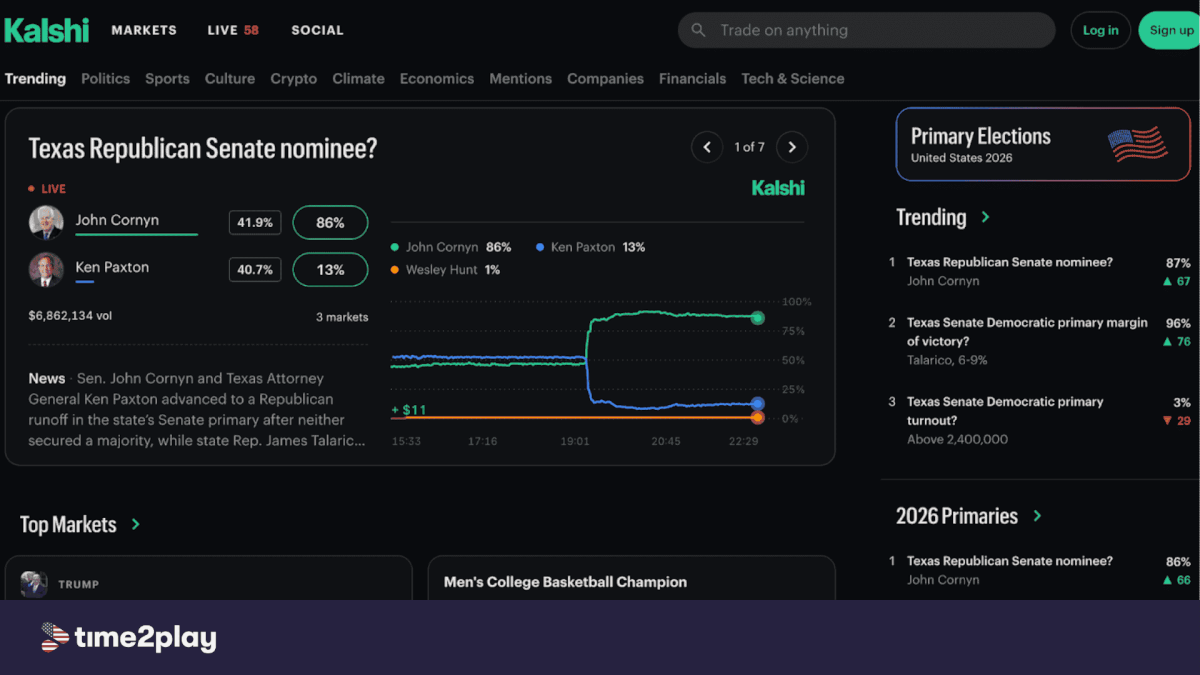
Kalshi feels like the only prediction market platform in the US that fully operates inside a clear federal framework. The pricing is transparent, the order book depth has improved materially over the past few years, and trading macroeconomic contracts like CPI or Fed rate decisions honestly feels closer to derivatives trading than traditional betting.

Pros
CFTC-regulated exchange
USD-based settlement with ACH withdrawals
Broad non-sports market coverage
Cons
State-level access restrictions remain
Liquidity varies significantly outside top political and macro contracts
Limited advanced trading tools
Key features
Federally regulated event contract exchange
Real-time order book with transparent pricing
ACH deposits and withdrawals in USD
Read our comprehensive Kalshi review to learn more about this prediction platform.
2026 status
Kalshi operates as a CFTC-regulated Designated Contract Market (DCM) under the Commodity Exchange Act, making it the first and most established federally regulated US event contract exchange offering retail-accessible prediction markets.
Contracts are settled in USD via ACH to verified US bank accounts. Access is available to eligible US residents who complete full identity verification (SSN required), though some states have attempted to restrict certain contracts.
🥈#2. Interactive Brokers
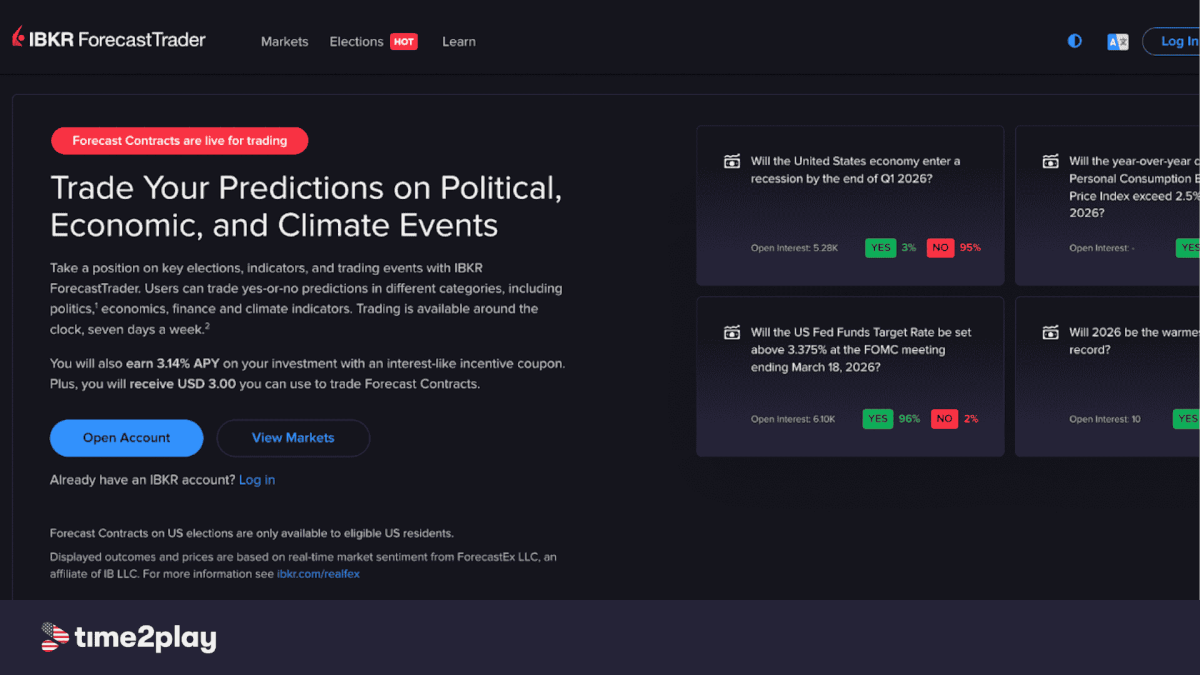
Interactive Brokers approaches prediction markets from a professional trading angle rather than a betting one. When I tested event contracts through IBKR, the experience felt closer to trading futures or options. You can expect precise order control, strong execution infrastructure, and serious risk management tools, but it’s clearly built for experienced investors, not casual speculators.
Pros
Access to CFTC-regulated event contracts
Institutional-grade trading tools and order types
Integrated within a global brokerage platform
Cons
Not designed for beginner traders
Limited promotional incentives or bonuses
Event contracts represent a small portion of platform focus
Key features
Advanced order routing and risk controls
Integrated margin and portfolio management tools
Direct brokerage funding in USD
Check out our Interactive Brokers Prediction Markets review to get our expert opinion on this new prediction site.
2026 status
Interactive Brokers provides access to event contracts listed on CFTC-regulated exchanges such as Kalshi, allowing eligible US clients to trade prediction-style derivatives through a standard brokerage account.
These contracts are regulated under the Commodity Exchange Act as federally overseen derivatives rather than state-regulated gambling products. Access requires a fully verified brokerage account and compliance with standard US trading and identity verification requirements.
🥉#3. Polymarket
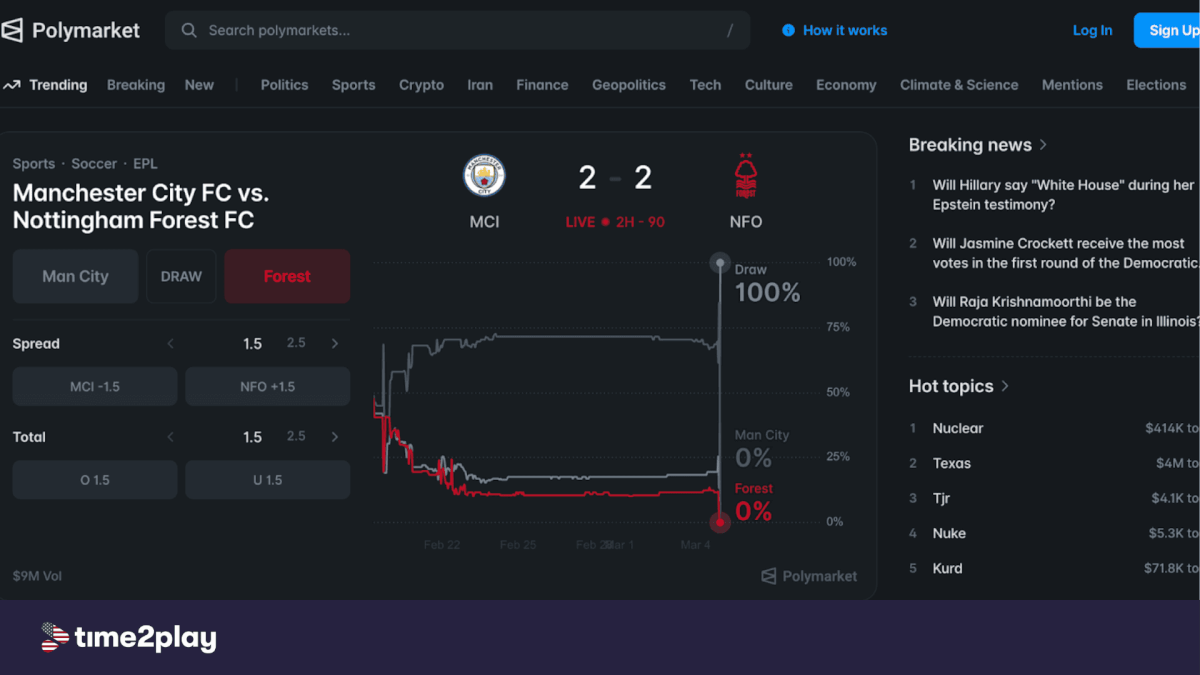
Polymarket is where I go when I want depth and speed. The liquidity during major political cycles is unmatched, price movements react instantly to breaking news, and the order book feels alive, but the crypto infrastructure and regulatory gray area make it better suited for experienced traders than casual users.
Pros
Highest liquidity during major political cycles
Transparent on-chain settlement using USDC
Deep global market participation
Cons
Requires crypto wallet and USDC for funding
Not CFTC-regulated for US users
US access restrictions and compliance limitations
Key features
USDC-based settlement on blockchain rails
Real-time order book with tight spreads on major markets
Wide range of political and global event contracts
Check out our detailed Polymarket review for expert advice on the site.
2026 status
Polymarket previously restricted US users after a 2022 settlement with the US Commodity Futures Trading Commission (CFTC) over offering unregistered event contracts. The platform began returning to the US market in late 2025 after acquiring QCEX, a CFTC-licensed derivatives exchange, creating a regulatory pathway for compliant operations.
As of 2026, Polymarket’s US rollout is limited and staged, with access gradually expanding through waitlist-based onboarding rather than the original open crypto trading model.
#4. OG
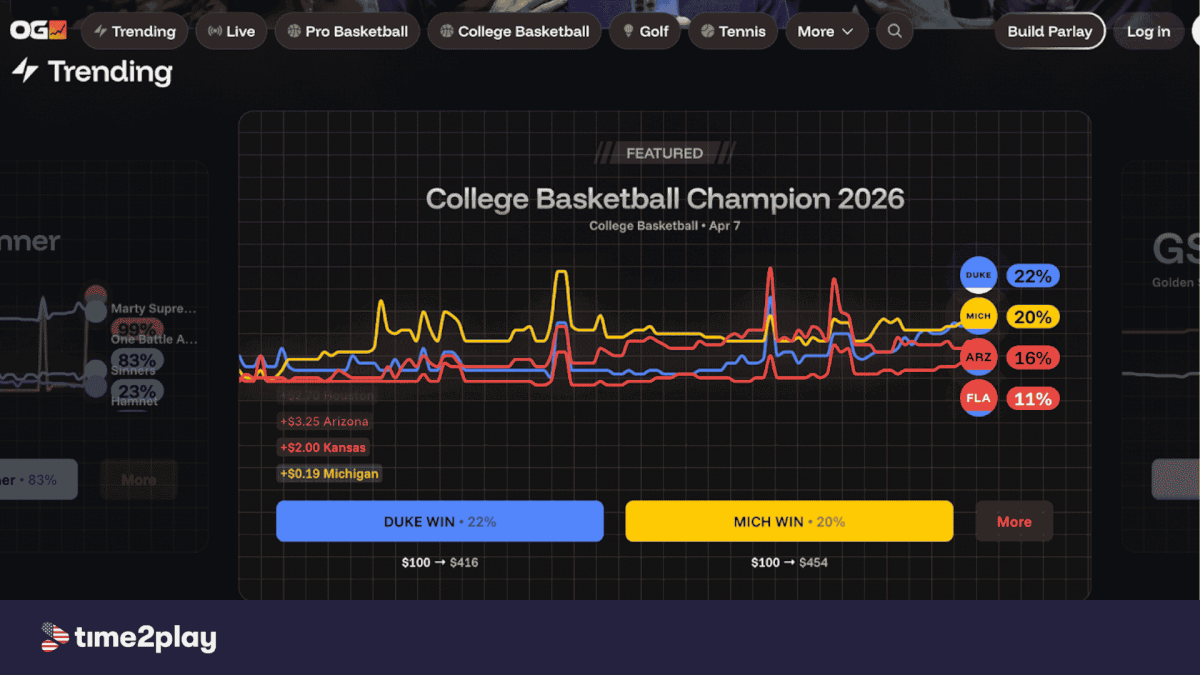
OG feels like one of the most interesting new prediction markets because it combines a highly user-friendly app with federally regulated event contracts. When exploring the platform, it felt closer to a modern trading app than a prediction exchange, with very strong sports coverage and a social layer that I suspect will attract more regular users rather than just professional traders.
Pros
Federally regulated event contracts through a CFTC-registered exchange
Strong sports market coverage and real time odds updates
Integrated mobile apps with social and leaderboard features
Cons
Very new platform with limited liquidity compared to established ones
Market depth still developing outside major sports events
Ecosystem highly dependant on Crypto.com infrastructure
Key features
Event contracts priced as probability markets across sports, politics, and finance
Mobile-first trading experience with social features and leaderboards
Potential future support for margin prediction contracts
Check out our in-depth OG review and learn more about this prediction platform.
2026 status
OG launched in February 2026 as a standalone prediction market platform backed by Crypto.com. The platform operates through Crypto.com Derivatives North America (CDNA), a CFTC-registered exchange allowing users to trade federally regulated event contracts tied to sports, financial indicators, politics, and cultural events.
The platform is currently focused on the US market, with access available through web and mobile apps, and plans to expand both internationally and into additional contract types such as margin-based event contracts.
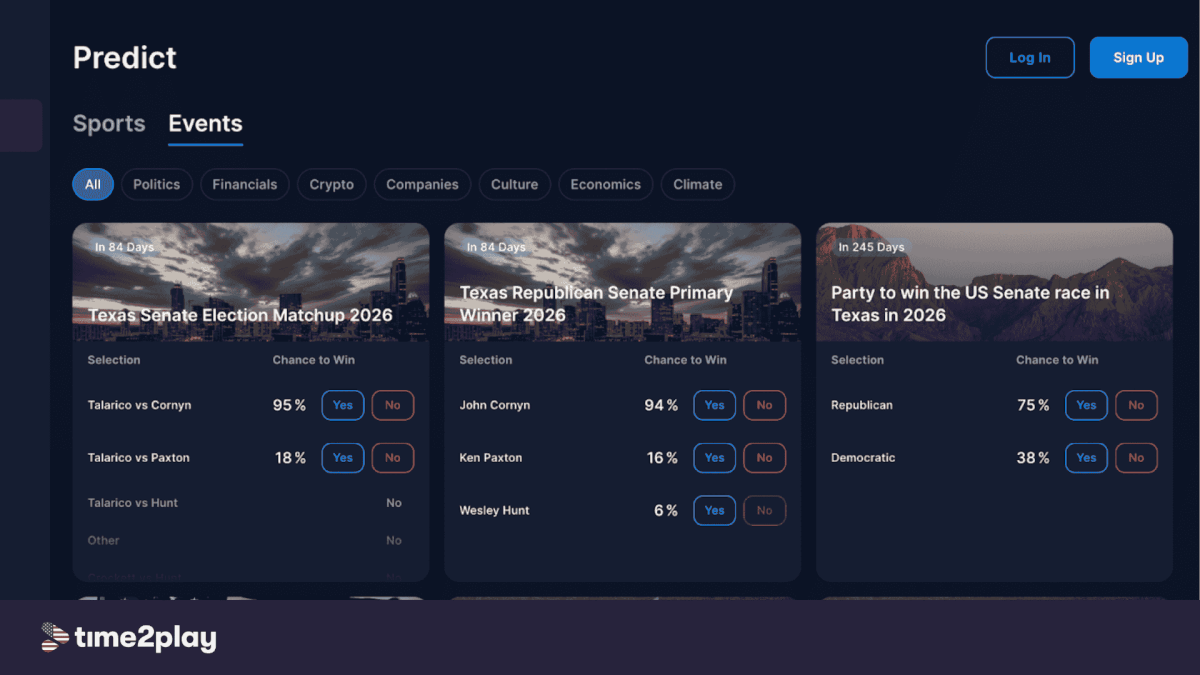
#5. Crypto.com
Crypto.com’s event markets feel like an extension of its broader trading ecosystem rather than a standalone prediction exchange. If you’re already active in crypto, the integration is seamless. Funding is instant, execution is smooth, and sports-focused contracts are easy to access, but it doesn’t offer the same regulatory clarity or contract depth as dedicated US exchanges.
Pros
Integrated within a major global crypto exchange
Strong sports event coverage
Instant crypto funding and settlement
Cons
Not a CFTC-regulated US event exchange
Event markets are secondary to core crypto trading products
Liquidity can vary significantly outside headline events
Key features
Event contracts are accessible within the Crypto.com trading app
Crypto-based settlement infrastructure
Finance-heavy contract offerings
Get more detailed information from our Crypto.com review .
2026 status
Crypto.com offers event-style prediction contracts within its global crypto trading platform, but the company is not registered with the US Commodity Futures Trading Commission (CFTC) as a Designated Contract Market for event derivatives.
As a result, US users generally cannot access the same event contract markets available internationally, and product availability depends on local regulatory rules. US customers can still use Crypto.com for standard crypto trading, but prediction-style contracts may be limited or unavailable for them.
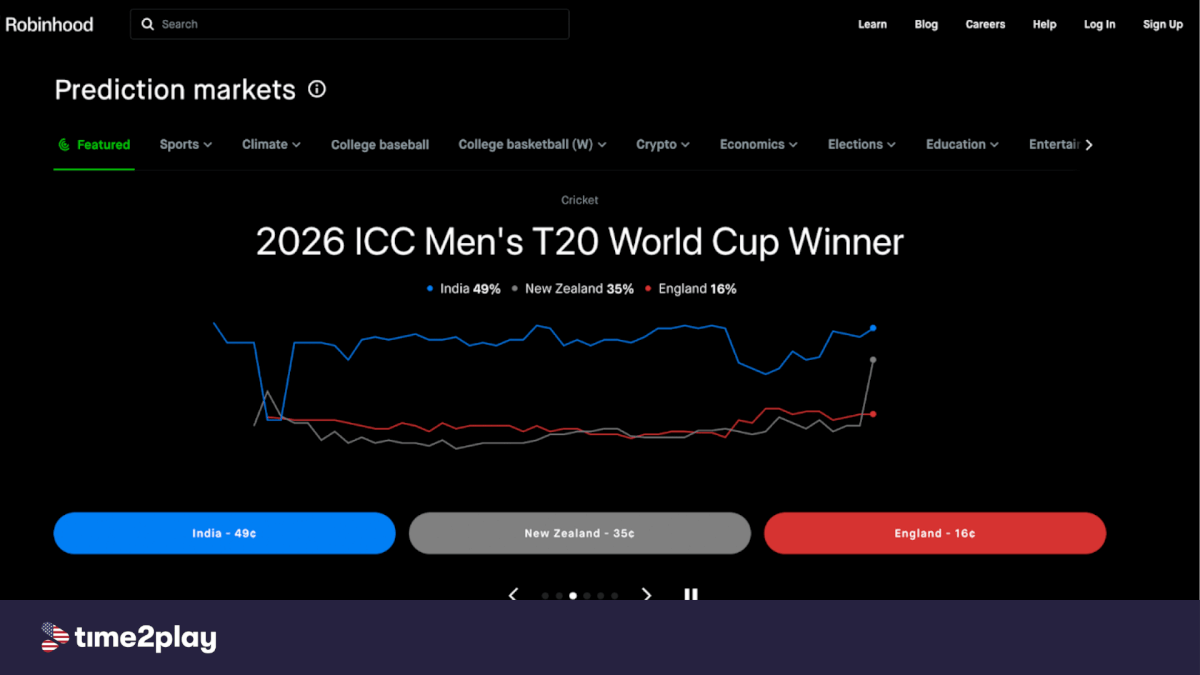
#6. Robinhood
I see Robinhood’s event contracts as the most accessible for mainstream investors entering prediction markets. The interface feels familiar, execution is seamless inside the brokerage app, and for users already trading stocks or options, adding political or macro event exposure requires almost no learning curve, though market depth is still behind dedicated exchanges.
Pros
Integrated inside a major US brokerage platform
Familiar, beginner-friendly trading interface
USD settlement directly within the brokerage account
Cons
Event contracts are available only through exchange partnerships
Narrower market selection compared to Kalshi or Polymarket
Liquidity depends on the underlying exchange depth
Key features
Commission-free brokerage infrastructure
In-app event contract trading
Instant funding via linked bank or brokerage balance
Find out more in our complete Robinhood review and breakdown.
2026 status
Robinhood offers event contracts in the US through its partnership with Kalshi, a CFTC-regulated Designated Contract Market (DCM). This means the contracts themselves are listed on a federally regulated exchange under the Commodity Exchange Act, while Robinhood acts as the brokerage interface for retail users.
Access requires a verified Robinhood brokerage account and full identity verification (SSN and government ID). Availability depends on the states where Kalshi is permitted to operate, and users must comply with federal trading rules that apply to event contracts.
#7. Underdog
While doing my research on Underdog’s recent trajectory, I’ve become convinced that this is a unicorn to follow. After just being ranked the 3rd top US Startup of 2025 by LinkedIn, the company goes through a bold reinvention, completely exiting traditional sports betting markets for prediction trading.
Through their partnership with Crypto.com (and soon their own exchange infrastructure) Underdog is blending the intuitive, user-friendly app experience of DFS with the novelty of YES/NO prediction trading contracts. 
Pros
Federally regulated exchange model, in 32 states, including California
Seamless integration in their fantasy app
Covers all major US leagues
Cons
Focuses mostly on sports prediction markets
No limit orders
Limited payment methods
Key features
All-in-one app for trading and DFS
Combo feature allows you to combine YES/NO predictions with up to 8 traditional Fantasy Pick’em selections
Cashout feature allowing to exit contracts early based on real-time market value
Check out our Underdog Predict review to see our opinions of this brand new expansion to the app.
2026 status
Underdog completely changed its business model heading into 2026. After exiting the traditional sports betting market entirely in late 2025, the company launched Underdog Predict (initially powered by Crypto.com).
In March 2026, Underdog acquired Aristotle Exchange, granting them their own CFTC- registered Designated Contract Market (DCM) and Derivatives Clearing Organization (DCO). This move will likely give them more legal flexibility and independence and potentially expand their footprint outside the current 32 states.
#8. Novig
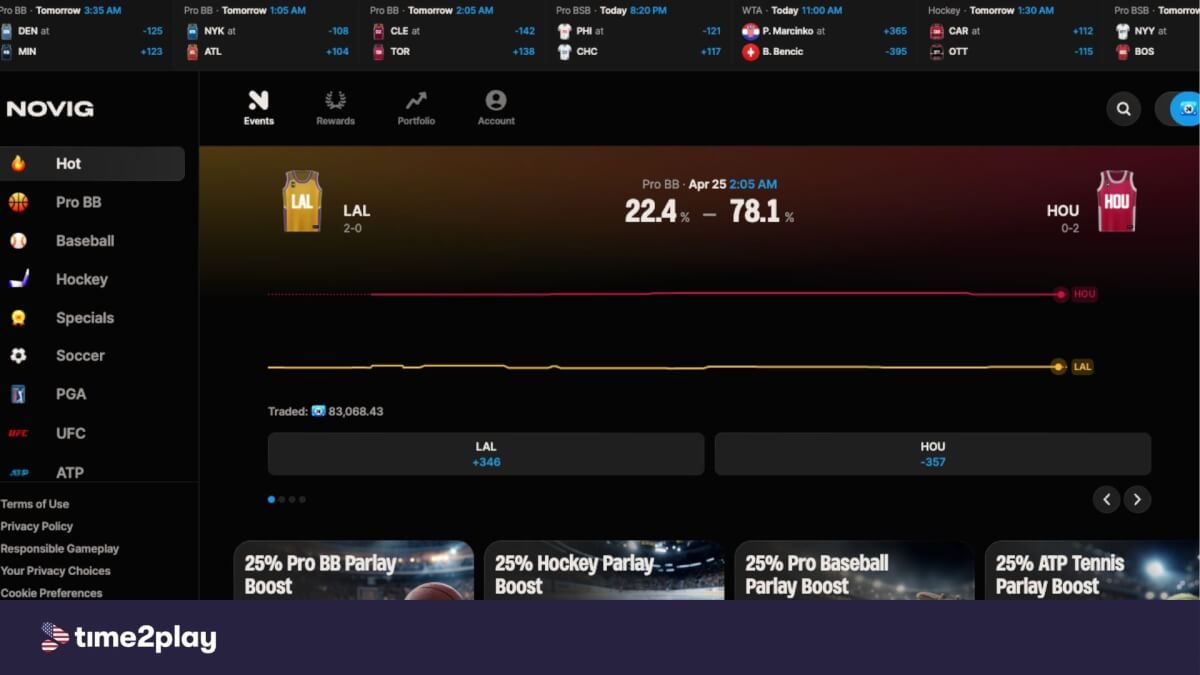
Novig is a game-changer for sports enthusiasts who are tired of the high “vig” (house edge) of traditional sportsbooks. By using a peer-to-peer model, Novig functions more like a financial trading platform for sports, offering some of the best prices in the industry.
Pros
Trade directly with other peers at 0% prices
Excellent live trading interface
Dual-coins model for social play
Cons
Sports-first focus
Requires a peer to match your bet
Key features
Mobile-first, with an UX made to look like a high-end trading app
Zero house edge (vig) commissions
Best for sports trading
Read our Novig review for more of our opinions about this trading platform.
2026 status
Because Novig follows a sweepstakes model allowing users to trade with both digital coins and real money equivalent (Novig Coins for the social mode and Novig Cash for real money play), it is available for sports trading in most US states, even the ones where online sports betting is not normally accepted.
At the same time, since it follows a peer-to-peer model, just like the other entries on this list, there is always a risk of lack of liquidity, as odd trading depends on the other players.
#9. PredictIt
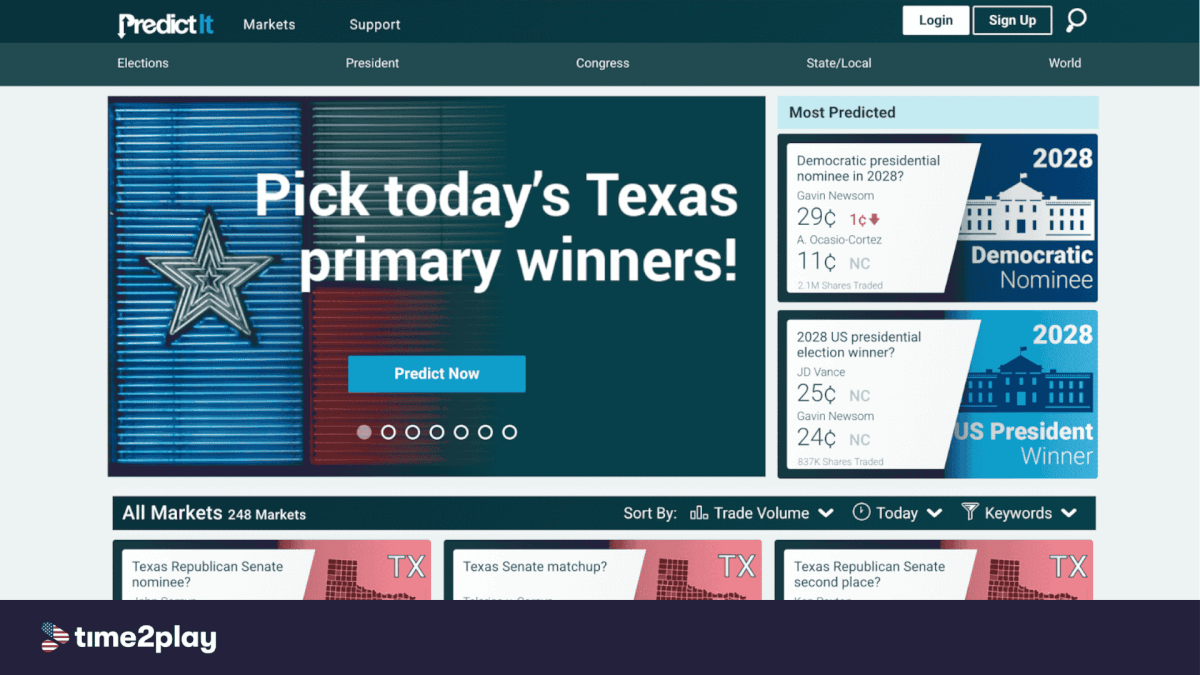
For me, PredictIt feels different from the other platforms. It’s more academic, more politics-focused, and less like a high-speed trading exchange. I’ve found it strongest for US election markets where retail participation is steady, but liquidity and position limits make it better for smaller traders than high-volume speculators.
Pros
Long-standing focus on US political markets
Simple, beginner-friendly interface
Low minimum entry per contract
Cons
Operates under a regulatory exemption rather than CFTC status
Strict position limits per contract
Limited market diversity outside politics
Key features
Share-based event contracts (priced $0.01–0.99)
Political market specialization
USD deposits and withdrawals
Learn how to trade on politics by reading our PredictIt review.
2026 status
PredictIt operates under a CFTC no-action letter issued for academic research purposes, allowing the platform to offer political event contracts without registering as a full Designated Contract Market. The exchange is run in partnership with Victoria University of Wellington as part of a research project studying prediction markets.
Because of this exemption, PredictIt enforces strict participation limits, including caps on the amount users can invest in a single contract and limits on the number of traders per market. Access is restricted to verified US users who complete identity verification, and the platform’s regulatory framework remains subject to periodic review by the CFTC.
What is a prediction market?
A prediction market is a platform where people trade contracts based on whether a real-world event will happen. These events can include elections, economic data releases, company performance, sports results, or global events. Traders buy or sell contracts depending on whether they believe the event is likely or unlikely to happen.
Unlike traditional betting, prediction markets operate more like financial exchanges. Instead of a bookmaker setting the odds, prices are determined by traders buying and selling contracts with each other. Because prices constantly adjust as new information appears, these platforms are often used both for forecasting future events.
How do prediction markets work?
Prediction markets use binary contracts, meaning each contract has only two possible outcomes: correct or incorrect. Most contracts trade somewhere between $0.01 and $0.99. If the event happens, the contract settles at $1.00; if it does not happen, it settles at $0.00. The price reflects the probability estimated by the market. For example, a contract trading at $0.55 implies a 55% chance the event will occur.
Traders can buy shares when they believe the market is underestimating the probability of an event. For example, buying 100 shares at $0.30 costs $30. If the event occurs and the contract settles at $1.00, the payout is $100, producing a $70 gross profit before fees. Because prices can move anywhere between $0.01 and $0.99, the value of contracts constantly changes as traders react to new information.
Another key feature is that traders can exit positions before the event ends. If you bought 100 shares at $0.30 and the price later rises to $0.70, you could sell immediately for a $40 profit (($0.70 − $0.30) × 100) instead of waiting for the final outcome.
Most platforms support market orders (instant trades) and limit orders (setting your preferred price), allowing traders to manage risk and lock in gains as probabilities change.
Prediction markets vs. traditional sportsbooks
Although prediction markets and sportsbooks both involve speculating on future events, they operate very differently behind the scenes. The biggest difference is how prices are created and who you are trading against.

Market mechanics
Prediction markets work as exchanges where users trade contracts with each other in an order book. Prices are determined by supply and demand among traders. Sportsbooks, on the other hand, set betting odds internally. A bookmaker calculates probabilities, adds margin, and takes the opposite side of each bet.

Fee structure
Sportsbooks build their edge directly into the odds through the vig (house margin), which typically ranges around 4–6% on standard bets. Prediction markets instead charge transaction or profit-based trading fees, while contract prices themselves are determined by the market rather than a bookmaker.

Liquidity and execution
Sportsbooks usually guarantee bets up to the posted limits at the listed odds. Prediction markets depend on order book liquidity, meaning large trades can move the price if the market is thin. However, heavily traded contracts like major elections or macroeconomic events can develop very tight spreads.

Regulation
In the US, sportsbooks are regulated by state gaming commissions, while many prediction markets fall under federal oversight from the CFTC when structured as event-based derivatives. This difference determines where platforms can operate and who is allowed to trade.
How to choose the best prediction market Platform
Not all prediction market platforms work the same way. Regulation, liquidity, fees, and funding options can all affect how easy a platform is to use, so before creating an account, review the key factors below.

Regulation and trust
Start by checking how the platform is regulated, as exchanges operating under the CFTC generally provide stronger legal oversight. Legitimate platforms also require identity verification, including government ID and often a Social Security number for US users. Then make sure to review whether the platform has faced regulatory disputes in the past, as this can signal potential risk. And lastly, understand how settlements work: US regulated platforms typically use bank transfers in USD, while crypto-native platforms may rely on stable coins or external wallets.

Market focus and diversity
Check which types of markets the platform offers and whether they match what you want. Some exchanges focus mainly on politics and economic indicators, while others emphasize sports, entertainment, or global events. Also look at how many markets are available and how frequently new contracts are listed, since active platforms usually add markets tied to current events and major news developments. Then make sure to review whether the exchange concentrates just on US events or if it supports global markets as well.

Liquidity (trading volume)
Always look at trading volume before entering a market. Higher liquidity usually means tighter spreads and easier execution. Review the bid-ask spread, and keep in mind that active contracts often trade with spreads around $0.01–0.02. Then check the order book depth to see how many shares are available at each price level, since thin markets can cause large trades to move prices, and activity spikes around major events such as elections, debates, or economic announcements.

Payment methods
Review how the platform handles deposits and withdrawals before you fund your account. Check whether it supports traditional banking methods like ACH, or if it requires crypto deposits such as USDC through a digital wallet. Make sure to also check how long deposits and withdrawals typically take, since bank transfers may require one to three business days, while crypto transfers can settle much faster. Lastly, look at minimum deposit requirements, withdrawal limits, and any additional funding fees.

Mobile app quality
If you plan to trade from your phone, you should evaluate the platform’s mobile app. Things to look for are fast order entries and reliable execution during volatile market movements. Check app store ratings and the number of user reviews to see how satisfied users are, and confirm that the app supports essential trading tools such as limit orders, market orders, and order-book visibility. Push notifications or price alerts that help you track market movements without constantly checking the app are also very useful.

Fees and pricing
Finally, review the platform’s fee structure carefully before trading. Check whether the exchange charges per-trade fees, a percentage of profits, or other transaction costs. Look at the bid-ask spread as well, since it acts as an indirect trading cost. For example, a $0.02 spread on a $0.50 contract represents about 4% trading friction. Also review deposit fees, withdrawal costs, and minimum payout requirements so you understand the total cost of using the platform.
How to get started with prediction markets
Trading successfully requires understanding how funding, contracts, and order types work. The steps below show how to open an account, place your first trade, and manage your position.

Step 1
Select your platform and create an account
Choose a platform that fits your goals and is available in your state. Create an account and complete identity verification (usually SSN and government ID on regulated US platforms). Most federally regulated exchanges require full KYC verification before you can trade.

Step 2
Deposit funds to your account
Fund your account securely using ACH, bank transfer, or brokerage balance on USD-based platforms. Crypto-native platforms may require USDC or wallet funding. Start with a small amount, since many platforms allow entry with $10–$50.

Step 3
Review the terms of the contract
Before trading, read the market rules carefully. Check the settlement conditions, expiration date, and the data source used to determine the final outcome. Clear rules help prevent disputes when the contract settles.

Step 4
Place your first trade
Start with a simple yes/no contract. Use a limit order if you want to control the price, or a market order if you want the trade to execute immediately. Keep position sizes small while learning how prices and spreads move.

Step 5
Manage and monitor your position
Watch how the price changes as new information enters the market. You can sell your position before settlement to lock in profits or limit losses. Use price alerts or notifications if the platform supports them.
Tips for new prediction market users
- Start small: Begin with small trades (for example, under $50 per contract) while you learn how prices, spreads, and settlement rules work.
- Check liquidity before trading: Look at the bid-ask spread and order book; tight spreads (around $0.01–$0.02) usually mean easier execution.
- Use limit orders: Setting your own price helps avoid slippage and prevents overpaying during fast market moves.
- Plan your exit in advance: Decide your profit target and loss limit before entering a trade (for example, buy at $0.40, target $0.70, exit below $0.25).
- Diversify your trades: Avoid putting all your capital into a single event such as one election or sports outcome.
- Avoid non-public information: Trading on insider information can violate platform rules and potentially lead to legal issues.
- Track your trades: Record entry price, exit price, position size, and fees so you can evaluate performance and report taxes accurately.
- Be careful around major events: Prices can move quickly during debates, earnings releases, or economic reports, so reduce position size if you can’t monitor the market.
How we rate prediction market sites
Time2play is dedicated to giving you the highest quality reviews, that are backed by data and market trends. In order to do this, we’re showing full transperancy by revealing our ranking methodology below:

Resolution
The ‘trust’ section of our rating. Here we look at how information is sourced for market trends and prices, how clear the site’s rules are, and how easy it is to settle a dispute if any problems crop up.
We review:
Resolution source quality
Clarity of rules
Dispute mechanism
Transparency of market creation
Liquidity
Here we look at how fair the prices of contracts are, both to buy and to sell. We expect sites to not have large gaps between the ‘buy’ and ‘sell’ options, and they should allow traders to limit their orders to a price of their choosing.
We review:
Order book depth
Bid-ask spread
Limit order support
Markets
Predictions markets would be nothing without the actual markets themselves. We look for 1,000+ tradeable markets, spread across 5+ categories. Our editors add points if they catch a particularly unique market offering.
We review:
Active market count
Category diversity
Market formations
Payments
A look at the payment options available, where we make sure all the popular methods are accessible, with fair and transparent transaction limits and speeds.
We review:
Number of payment methods
Withdrawal speed
Deposit time
Deposit limits
Transparency of payment policy
Fees
Unlike sportsbooks that make money through the ‘vig’, predictions markets make use of fees to turn a profit. While understandable, we make sure that the fees stay fair, with trading fees below 0.5% and minimal transaction fees.
We review:
Trading fees (Maker/Taker)
Winner tax (Profit Commission)
Withdrawal and deposit fees
Safety
Time2play takes safety very seriously, which is why we dedicated a whole rating section to it. We want our prediction markets to be licensed, regulated, and with a full suit of RG tools and security settings like 2FA.
We review:
Regulatory status
Fund segregation and audits
Account security (2FA/Encryption)
Responsible trading tools
Mobile
Prediction markets are much more prevalent on mobile devices then other sites, and se we have higher standards for their apps. We look for a neat, easy-to-use design with zero lag and glitches.
We review:
App availability and performance
Mobile UX/UI design
Support
Finally, we look at the support itself, how helpful it is, and what educational resources it provides. A helpful community is a bonus, with a large community presence benefiting everyone on the site.
We review:
Customer support quality
Community engagement and social presence
Educational resources
Legal and regulatory landscape for prediction markets in the US
US prediction markets operate under a different legal framework than traditional sportsbooks.
- Federal oversight: Some platforms, such as Kalshi, operate under the Commodity Futures Trading Commission (CFTC) as federally regulated exchanges that list event-based derivatives.
- Exempt platforms: Certain markets, like PredictIt, have historically operated under a CFTC no-action or research exemption, which allows limited trading without full exchange registration.
- State pushback: Some states have challenged prediction markets, arguing that certain contracts resemble unlicensed gambling, which can lead to restrictions or enforcement actions.
The legal framework can be confusing because prediction markets are somewhere between financial regulation and gambling law. While sportsbooks are licensed by individual states, many prediction markets fall under federal commodities law, meaning they may operate legally even in states where sports betting is not yet permitted.
This federal classification has allowed regulated exchanges to launch real-money prediction markets tied to events such as elections, economic data releases, and macroeconomic indicators. State regulators occasionally challenge these markets, arguing they resemble gambling rather than financial derivatives.
When it comes to taxes, prediction market winnings are generally taxable in the US. Depending on the platform structure, profits may be reported as capital gains or gambling income, and users are responsible for reporting earnings to the IRS and maintaining records of their trades.
Key prediction market trends for 2026
Prediction markets are changing very quickly. In 2026, several trends are likely to influence how platforms operate, how traders participate, and which markets attract the most liquidity.
Expansion of federally regulated markets
CFTC-regulated exchanges like Kalshi have moved prediction markets closer to the financial system. As regulators continue reviewing event contracts tied to elections, economic data, and sports, more platforms may seek federal approval to launch compliant markets in the US in 2026.
Liquidity concentration around major political cycles
Prediction markets historically see their largest trading volumes during major elections. During the 2024 US election cycle, political contracts on platforms like PredictIt generated hundreds of millions in trading activity. Similar spikes are expected during upcoming election cycles and major political events.
Brokerage integration expands access
Major trading platforms are beginning to experiment with event contracts. Brokerages such as Robinhood and Interactive Brokers have already started offering access to prediction-style contracts through regulated exchanges. This could potentially bring prediction markets to millions of existing retail investors.
Competition between regulated and crypto markets
Two different models are emerging: regulated US exchanges and crypto-native global platforms. Regulated exchanges emphasize compliance and bank-based funding, while crypto platforms focus on global liquidity and blockchain settlement. This competition will likely shape how the industry develops over the next few years.
Expansion beyond political markets
While politics initially drove most trading activity, platforms are expanding into macroeconomic indicators, inflation data, and global events. Markets tied to interest rates, economic releases, and major news events are becoming increasingly common, and will probably continue to expand in 2026.
Stronger compliance and market controls
As regulators pay closer attention to prediction markets, platforms are adding stricter safeguards. These include position limits, identity verification, and monitoring systems designed to prevent manipulation and ensure markets comply with financial regulations.
Conclusive summary
Prediction markets have moved from niche forecasting tools to active trading platforms where users can speculate on elections, economic data, and major global events. Regulation and platform competition are shaping how these markets operate, particularly in the US where federal oversight and state rules both influence availability.
For new users, the most important factors are choosing a trustworthy platform, understanding how contracts are priced, and managing risk carefully. Liquidity, fees, and market variety can vary significantly between platforms, which means doing some research before trading can make a meaningful difference.
Prediction markets can offer useful insights into how people view future events, but they are still speculative markets, which means that prices can move quickly. Start with small trades and learn how pricing works before committing larger amounts.
In 2026, clearer regulation, new platforms, and wider adoption may make prediction markets more accessible to everyday traders. For now, the best way to approach it is to understand the basics and choose the right platform.
FAQs
Are prediction markets legal in the US?
Yes, but it depends on the platform. Certain platforms operate under federal oversight from the Commodity Futures Trading Commission (CFTC). For example, Kalshi is a federally regulated exchange that allows users to trade contracts on real-world events.
Other platforms may operate under special research exemptions or outside US regulation, which can limit access for US users. In addition, some states may challenge or restrict certain markets.
What is the difference between a prediction market and a sportsbook?
In a sportsbook, you place a bet against the bookmaker. The sportsbook sets the odds and includes a margin (called the vig), which ensures the house makes money over time.
In a prediction market, users trade contracts with each other instead of betting against the platform. Prices move based on supply and demand and reflect the market’s estimated probability of an event happening. You can also sell your position before the event ends, which allows you to lock in a profit or limit losses.
Can you actually make real money on prediction markets?
Yes, it’s possible to make money on prediction markets. Each contract pays $1.00 if the outcome is correct and $0.00 if it isn’t. For example, if you buy a contract at $0.40 and it settles at $1.00, you earn $0.60 per share before fees.
However, profits are not guaranteed. Prices can move quickly, and you can lose money if the market moves against you or the event resolves differently than expected. Fees, spreads, and market liquidity can also affect your final return.
What is the best prediction market for politics and elections?
It depends on what you are looking for. If you want a regulated platform available to US users, Kalshi and PredictIt are two of the most commonly used options for political markets. If you are looking for higher global trading volume, platforms like Polymarket often attract large liquidity during major election cycles. The best choice ultimately depends on your location, the markets available to you, and whether you prioritize regulation or trading activity.
Do I have to wait for the event to end to get paid?
No. You can sell your position before the event ends if the price moves in your favor. For example, if you buy 100 shares at $0.30 and the price later rises to $0.70, you could sell them for a $40 profit (before fees). Many traders use this approach to lock in gains or reduce losses without waiting for the final outcome of the event.
Are prediction market winnings taxable?
Yes. In the US, profits from prediction markets are generally taxable. Depending on how the platform is structured, earnings may be treated as capital gains or gambling income. Traders are responsible for reporting their profits to the IRS, even if the platform does not send a tax form. Keeping records of your trades, deposits, withdrawals, and fees can make tax reporting easier.
How do I deposit and withdraw money?
Funding methods depend on the platform you use. US regulated prediction markets usually allow deposits and withdrawals through ACH bank transfers or linked brokerage accounts. Crypto-based platforms often require funding through stablecoins like USDC or a crypto wallet instead of a bank account.
Sources
- https://www.reuters.com/sustainability/boards-policy-regulation/short-take-us-cftc-ships-prediction-markets-rule-proposal-trump-budget-office-2026-03-03/
- https://www.reuters.com/business/robinhood-expands-sports-event-contracts-rivals-flood-industry-2025-12-17/
- https://www.reuters.com/business/finance/robinhood-expands-betting-footprint-with-prediction-markets-launch-2025-03-17/
- https://www.ft.com/content/2f07aed7-58b0-45d3-87d4-c3c883a616fa
- https://www.cftc.gov/LawRegulation/CommodityExchangeAct/index.htm
- https://www.irs.gov/taxtopics/tc419
- https://www.irs.gov/taxtopics/tc409

Paul Portanier
VerifiedContent Editor
Paul Portanier has been writing in the iGaming sphere since 2021. Starting as a self-employed writer, his detail-oriented approach, research accuracy, and dedicated work ethic led to him being offered a full-time position at Time2play.
He aims to bolster Time2play’s content with data-driven content and accurate analyses of all US gambling operations.
Security & Standards
I only recommend trusted brands, and every sweepstakes casino I rank is independently tested.