
Robinhood Prediction Markets review 2026: Trade event contracts inside the Robinhood app
Robinhood is expanding past stocks and crypto by adding prediction markets to its app. Now you can trade event contracts, and the price shows how likely the market thinks an event is to happen.
In this review, I’ll explain how the feature works, what types of markets you can trade, how the costs compare to platforms like Kalshi and Polymarket, and whether it’s worth trying.

Robinhood key takeaways
Built directly into the standard Robinhood app
Fully available in 48 states
Runs on Kalshi, a CFTC‑regulated event contract exchange
Markets span sports, economics, politics, crypto, and culture
You need a Robinhood brokerage account plus derivatives access
Editors note
This review is based on the operator’s current offer. Data and analysis are accurate at the moment of publishing but can be subject to change as the operator’s offer adjusts over time.
What is Robinhood Prediction Markets and how does it work
Robinhood Prediction Markets is an add‑on inside the main Robinhood app that lets you trade on outcomes. Each market is framed as a yes/no question about something in the real world, for example, an economic release, a political result, or a sports outcome.
Behind the scenes, Robinhood routes these trades to KalshiEX, a CFTC‑regulated exchange that handles the order book and settlement. You never leave the Robinhood interface, but the contracts themselves live on Kalshi.
Each outcome is priced between $0.01 and $0.99. That price is effectively the market’s current estimate of the probability the event will happen. If the outcome you backed is confirmed, the contract pays out $1 per share. If it doesn’t happen, the contract goes to $0 and you lose the amount you spent.
Once you buy into a market, you don’t have to wait for the contract to resolve. You can sell your contracts back to the market at the current price. If the price has moved up in your favor, you can close out early and take profits, and if it moves against you, you can sell to reduce your loss.
Thanks to the Kalshi partnership, Robinhood can offer prediction markets in most US states. However, event contracts are not available in Maryland, and users in Nevada cannot trade new sports-related event contracts.
Pros
CFTC‑regulated infrastructure via Kalshi
Broad mix of categories (sports, macro, politics, crypto, culture)
Lives inside the existing Robinhood app and portfolio
Supports limit orders and live, order‑book style trading
Cons
Limited availability in some states
Small per‑contract fees and bid‑ask spreads can add up
Smaller active market depth compared to Kalshi
Interface is designed for general investing, not prediction trading
Robinhood Prediction Markets app review
You can use Robinhood Prediction Markets right in the main Robinhood app on iOS, Android, or desktop. It’s part of the regular trading platform, so you can trade event contracts along with your stocks and options.
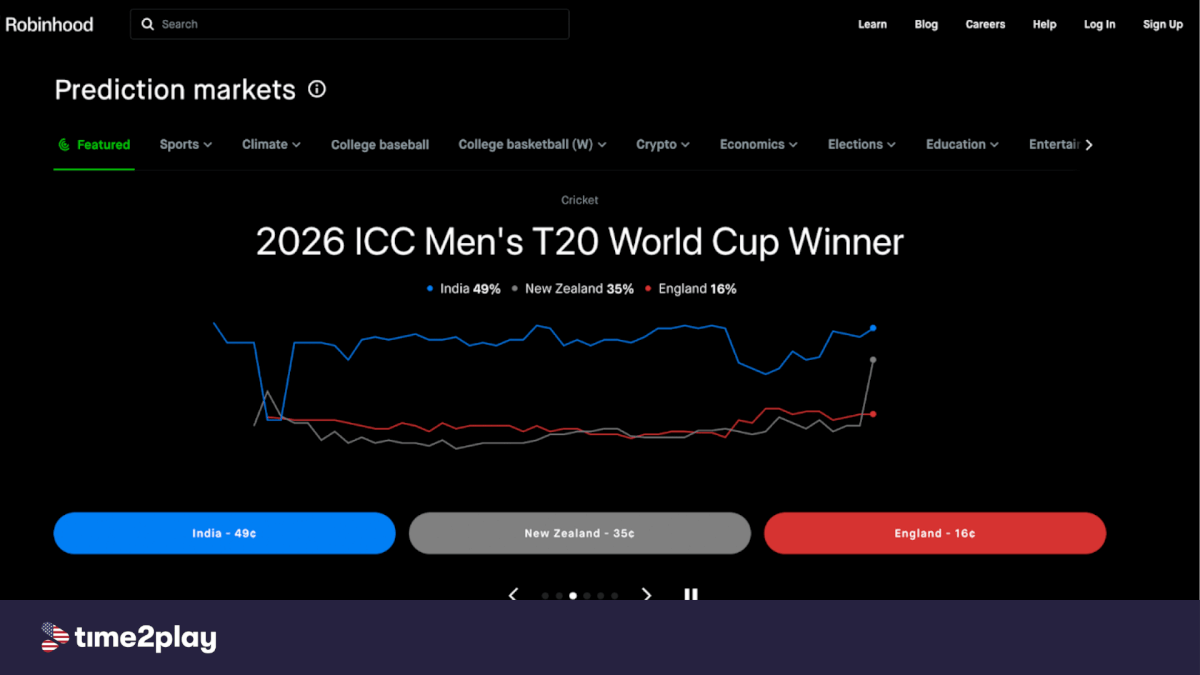
You find markets by browsing categories and featured events, with contracts on topics like economics, politics, sports, and finance. Markets show prices, probabilities, and simple charts, so it’s easy to scan and trade quickly.
The platform is simple, with basic order tickets and a few trading tools. This makes it easy for current Robinhood users, but it’s better for quick trades than for deep market analysis.
Mobile rating: 98/100
Using Robinhood Prediction Markets feels more like turning on an extra feature in the same app than learning a new platform from scratch. I could jump between my stocks and event contracts in a couple of taps, and everything lives in the same view.
Finding markets is super easy if you’re familiar with Robinhood’s layout. I scrolled through sections like economics, politics, and sports, and it worked just like the rest of the app with simple lists, quick filters, and clear charts. If you like an event-focused layout, where everything centers on one game or election, this setup might feel a bit generic.
The main advantage here is clarity. Each contract page shows the current price and implied probability right away, so I always had a good idea of the odds and possible payout. There isn’t a lot of extra data, but that’s on purpose, since Robinhood prefers to keep the screens simple.
Placing a trade works almost the same as buying a stock or option on Robinhood. I tapped into a contract, chose how many shares I wanted, checked the total cost, and confirmed, so if you already use the app, there’s hardly any learning curve.

Different prediction markets available at Robinhood
Robinhood prediction markets are grouped into 11 main categories, including politics, sports, crypto, economics, climate, technology, and global events, but there are also niche areas like chess.
The number of available markets in each category varies with live events, but some sections have dozens of active contracts at once. For example, election markets might have 15 to 20 contracts, crypto markets about 20 to 30, and esports or sports categories can list many active contracts at the same time.
This gives you more options, but the experience feels less organized than on platforms focused on specific events. Robinhood definitely has a wider range of prediction markets than sports-only platforms, but with fewer active contracts at once, it feels more like a curated list than a large, open marketplace.
Market variety rating: 85/100
What stands out about Robinhood is the variety of themes you can explore. In just a few minutes, I moved from Fed decisions and inflation reports to political races, crypto milestones, and niche areas like chess and esports.
There are some trade-offs, though. You don’t get the full coverage you see on dedicated prediction exchanges or big sportsbooks, as most events only have a few contracts, and after browsing the main categories, you quickly get a feel for the whole catalog.
For users who are more interested in following real-world events than betting on every detail of a single game, this setup works well. Opening a contract tied to an economic report or a major election feels more like tracking a financial story than looking at a betting slip.
Robinhood does fall behind in volume, though. Platforms like Polymarket offer many more contracts across politics, culture, and global news. Robinhood feels more curated, with something interesting to trade most of the time, but it doesn’t try to cover every possible outcome.
How to trade on Robinhood Prediction Markets
Robinhood Prediction Markets display outcomes as contracts priced from $0.01 to $0.99, depending on how likely traders think the event is. The higher the price, the more likely the market thinks it will happen. If your prediction is correct, each contract pays out $1.
For example, if you buy 20 contracts at $0.20 each, you spend $4.00 before fees. If your prediction is correct and the contracts settle at $1, you get $20 back, making a $16 profit before fees.
You can also sell contracts before the event settles. If the price goes up after you buy, you can sell early to lock in a profit, and if the market moves against you, selling lets you exit and limit your losses.
Robinhood also lets you use multi-leg “combo” contracts, where you combine several outcomes into one position. These can be preset combinations or custom setups with up to 10 legs, so you can make more complex predictions in a single trade.
KYC verification: Why Robinhood requires identity verification
To use prediction markets on Robinhood, you go through the same identity checks required for a standard brokerage account. During signup, Robinhood will ask for personal information such as your name, address, date of birth, and Social Security Number, and may verify those details through third‑party services.
Event contracts on Robinhood are offered through KalshiEX LLC, a derivatives exchange supervised by the US Commodity Futures Trading Commission (CFTC), which is why Robinhood has to confirm who you are, where you live, and whether you’re eligible to trade. These checks are also used to block fraudulent accounts and make sure users aren’t accessing contracts from restricted jurisdictions.
Quick orders vs. limit orders
Robinhood lets you trade prediction contracts either at the current market price or at your own price, but under the hood, these orders use specific execution types.
Basically, if you want speed, you’re placing an immediate-or-cancel (IOC) order. Your trade goes through instantly at the best available price, and any part that isn’t filled is canceled right away. It’s the fastest way to enter or exit, but you can’t control the exact price.
If you want more control, you can use a limit order. These are set as good-til-date (GTD) orders, so they stay active until they’re filled or expire, usually at 3 AM ET the next day. Here you can pick the price you want, and the order waits for someone to match it.
Trading on Robinhood Prediction Markets feels smooth if you’ve used Robinhood before. I opened a contract, checked the price and implied probability, chose how many shares I wanted, and confirmed, just like making a stock trade.
Being able to choose between IOC and GTD orders is a pretty good balance. IOC orders are great for getting in or out fast, while GTD orders help if you want a specific price, so it’s more flexible than platforms that only let you use the displayed price.
Compared to Kalshi’s own interface, Robinhood definitely has less detail. There’s less information on screen and fewer advanced tools, which can be good for new traders. For active prediction market traders, the main issue is liquidity, as some contracts don’t have enough activity, so even a well-placed limit order might not get filled.
So, if you’re already familiar with Robinhood, trading event contracts here feels natural, and it’s good for people who like prediction markets but don’t want a separate, more technical platform.
Robinhood Prediction Markets payment methods
Robinhood Prediction Markets uses the standard Robinhood funding system, so there is no separate wallet for event contracts. There are three payment methods: ACH bank transfers, debit card deposits (Visa and Mastercard), and Apple Pay.
ACH transfers typically take 3–5 business days to fully settle, although Robinhood offers instant deposits for eligible accounts. These instant deposits let you start trading immediately, even before the transfer is completed, with limits that depend on account status and history.
Robinhood doesn’t charge deposit fees for either ACH or debit funding. There is no officially stated minimum deposit, but accounts can generally be funded with amounts as low as $1.
Withdrawals are processed only via ACH transfer. Once a withdrawal is initiated, it is usually processed within one business day, and funds typically arrive within 1–3 business days. Robinhood does not charge withdrawal fees, but recently deposited funds are subject to a standard settlement period of up to 5 business days, so they cannot be withdrawn until they are fully cleared.
Payments rating: 80/100
Funding prediction markets on Robinhood is just like funding your regular brokerage account. I linked my bank, used an ACH transfer, and saw the funds show up quickly thanks to instant deposits.
The trade-off on Robinhood is flexibility, since you’re mostly limited to bank transfers and debit cards. That’s easy for most US users, but if you’re used to platforms with e-wallets or crypto deposits, Robinhood feels more traditional.
Withdrawals follow the usual brokerage timelines. When I requested a withdrawal, it went out via ACH and arrived in my bank after a few days. There’s no instant cash-out option, and if your recent deposits or trades haven’t settled, that can slow things down.
I’d say the payment setup is the same as Robinhood’s main product, which means it’s simple, familiar, and reliable, but not built for super-fast moving money in and out.
Robinhood Prediction Markets fees and payouts
The main cost on the platform is Kalshi’s fee, which is included in each trade. Robinhood charges a $0.01 commission per contract, and the exchange typically adds another $0.01 per contract or embeds the cost into the spread. For example, buying 5 contracts might add about $0.05 to $0.10 in trading fees to your order.
If your prediction is correct, each contract pays out $1, and your profit is the difference between what you paid and the $1 payout, minus any trading fees. If you’re wrong, the contract settles at $0, and you lose what you spent.
Compared to traditional sportsbooks, this setup can feel a lot more efficient. Sportsbooks usually have a built-in margin of about 7–10%, while prediction market prices are set by supply and demand. Since you can sell contracts before settlement, you can lock in profits or cut losses as prices change, which gives you more flexibility than fixed-odds betting.
Fees rating: 82/100
The fee structure on Robinhood Prediction Markets is simple, but it’s not as clearly shown as on some other platforms. Since everything goes through Kalshi, the cost is included in the trade, and you usually see a small per-contract fee before confirming your order.
I noticed the fee isn’t always shown as a separate line. You see the total cost of the trade, but unless you look closely, it’s not clear how much is for fees versus the contract price. It’s still transparent, just less obvious than on platforms that show the exact fee per contract.
The fee can add up with bigger trades, so even though it’s small per contract, it becomes more noticeable if you trade large volumes or move in and out often. Still, compared to a sportsbook’s margin, it’s usually cheaper, especially if you get good prices.
Compared to other prediction markets, Robinhood is similar to Kalshi since it uses the same backend. The fee setup is fair and competitive, but it might not be the cheapest choice depending on how you trade.
Is Robinhood Prediction Markets safe?
Robinhood Prediction Markets operates within the US financial regulatory framework. Event contracts available on the platform are traded through KalshiEX LLC, a derivatives exchange regulated by the CFTC. This means the platform must follow federal rules related to market integrity, reporting standards, and anti-fraud protections.
The platform uses industry-standard security measures, including 256-bit SSL encryption to protect user data and transactions. Users can also enable two-factor authentication (2FA), along with additional security features like device verification and login alerts, to add an extra layer of protection beyond a password.
As a regulated brokerage platform, Robinhood also includes built-in account protections such as withdrawal verification, fraud monitoring systems, and account activity alerts. Funds held in brokerage accounts are protected under SIPC insurance, although this protection does not cover trading losses.
Unlike some gambling-focused platforms, Robinhood does not offer dedicated responsible gaming tools such as self-exclusion or betting limits specifically for prediction markets. However, you can manage risk through brokerage-level controls, including account restrictions and funding limits tied to regulatory requirements.
Safety rating: 84/100
From a safety and oversight perspective, Robinhood’s prediction markets feel much more like a brokerage product than a betting app.
I had to complete full identity checks and provide personal details, including my Social Security Number, before I could access event contracts. It’s more of a hassle than on some crypto-based platforms, but it shows that real compliance work is happening behind the scenes.
For security, Robinhood offers the usual tools: encrypted connections, device checks, two-factor authentication, and account alerts. I also like that funds in your brokerage account are SIPC-protected. It basically covers all the basis, and you’ll feel pretty safe using the platform.
Robinhood Prediction Markets comparison
| Comparison topic | Robinhood | Kalshi | Polymarket |
|---|---|---|---|
| Welcome promo | N/A | Trade 100 contracts, get $10 | Deposit $10 get $25 |
| Existing user promos | N/A | Referral program, Bug Bounty | Liquidity Rewards Program |
| Apple Store rating | 4.2/5 | 4.7/5 | 4.7/5 |
| Google Play rating | 4.1/5 | 4.1/5 | 3.7/5 |
| Accepted payment methods | ACH, Visa, Mastercard, Apple Pay | Debit cards, bank transfer, wire transfer, crypto | Visa, Mastercard, bank transfer, wire transfer, Apple Pay |
| Minimum deposit | $1 | $5 | $1 |
| Trading fees | $0.01–$0.02 | $0.01–$0.02 | None |
| Available US states | 48 US states (restricted MA and NV)) | All 50 states | Available through waitlist |
FAQs
Is Robinhood Prediction Markets legal in all US states?
No. Availability depends on state regulations. Event contracts are not available in Maryland, and users in Nevada cannot trade new sports-related event contracts.
How do I get Robinhood’s welcome bonus?
Robinhood does not currently offer a dedicated prediction market welcome bonus.
Is sports betting available on Robinhood?
No. Robinhood offers event contracts, not traditional sportsbook betting. These are regulated financial products with contracts priced between $0.01 and $0.99 that settle at $1 if the prediction is correct.
Robinhood user reviews
Do you have any experience with this operator?