

There’s a lot to consider when it comes to planning the World Cup; it can take host nations decades to be fully ready to host sport’s biggest event. One of the more modern considerations is whether the stadiums are digitally equipped to handle the influx of data from the projected record 3.5 million attendees.
During the final group stage, there will be no less than 24 matches scheduled to take place simultaneously. This will give viewers even more reasons to go online and check scores, contact friends, and even stream other games while in the stadium. Given the number of fans and phones that will descend upon them, the stadiums must be digitally equipped.
At Time2play we’ve done the research to find out which of the stadiums across the 16 host cities are best prepared for the 2026 World Cup and which ones will be buffering.
How did we determine digital readiness?
There’s a lot to consider when determining the digital readiness of the World Cup stadiums, so we broke down our criteria into six key factors.
| Factor | What we considered |
|---|---|
| Digital infrastructure | WiFi type DAS connection points Number of monitors Number of access points |
| Download speed | Speed at which data can be downloaded in the stadium |
| Compared to Qatar speeds | Comparing download speeds on offer at the 2026 stadiums Qatar 2022 stadiums |
| Data sent per game | Amount of data that a stadium was able to handle per game |
| Peak speed of data sent per person | Using seating capacity and WiFi speeds, we calculated the top speed of data for each person |
| Fan features | Order to seat capability Cashless systems AR integration |
Our formula
We found the data for each of these factors for the 16 World Cup host stadiums and used a bracket system to score them. For example, a stadium with a download speed of between 360mbps and over scored ten points, while a stadium with speeds between 320 and 360mbps scored nine. This continues down until we get to one point for stadiums with speeds between 20 and 40mbps.
We repeated this process for each of the factors and stadiums, then added the scores together for an overall score. Once we’d done that, we simply divided by the number of factors we were considering (six) for the average score of each.
All 11 American stadiums best prepared
Our rankings found that the American stadiums are significantly better prepared to handle the digital strain of hosting the tournament. They completely locked down the top ten spots with San Francisco finishing in first place.
In fact, all the American cities place above those from Mexico and Canada. The highest ranked non-US city, Vancouver, finished in 12th with a score of 4.2 — quite a fall from the lowest rated American host, Kansas City, which banked 5.2.
Take a look at our rankings of the digital readiness of each of the 2026 World Cup host cities:
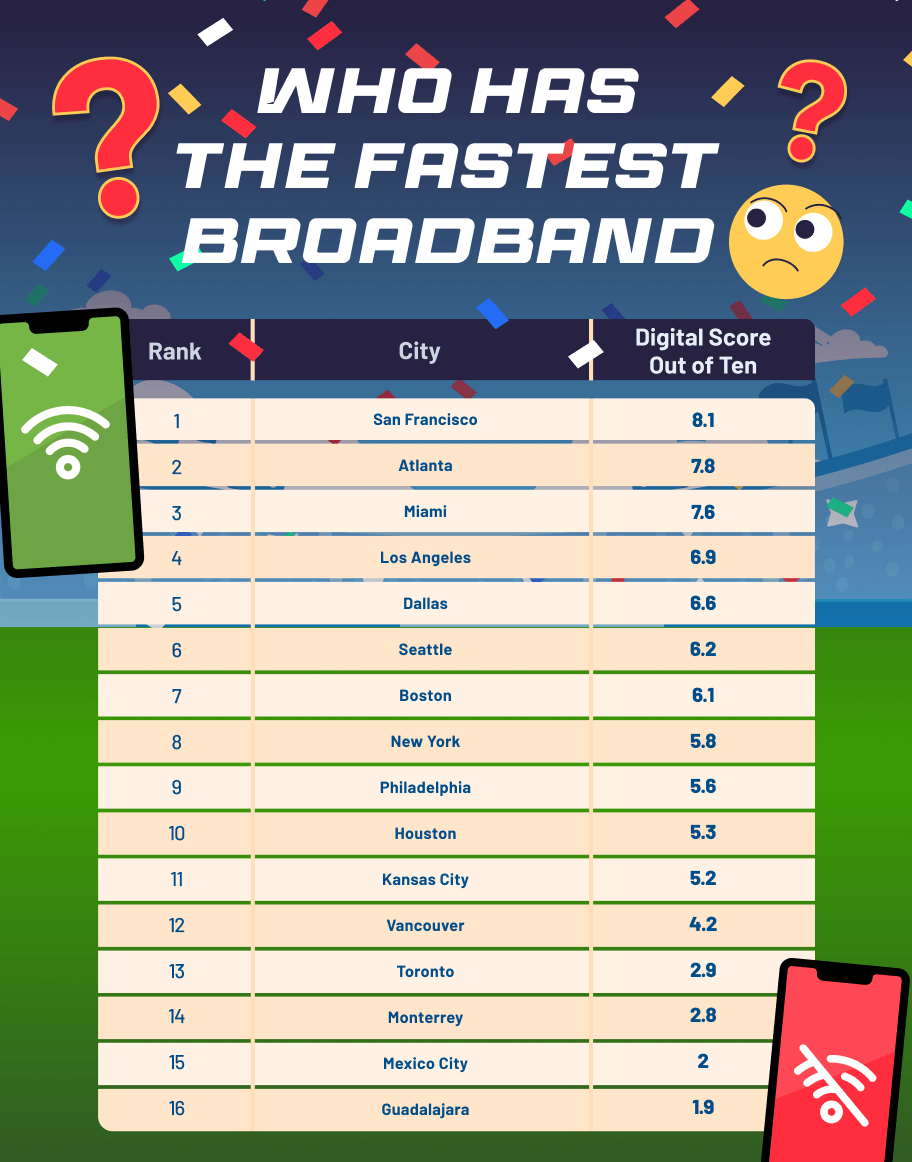
Most prepared: San Francisco 8.1/10
It will come as little surprise to many to see San Francisco taking the top spot given that it includes the likes of Silicon Valley, a global hub for technology. The San Francisco Bay Area, where the Levi’s Stadium is located, is also one of the biggest financial centers in the world with a GDP of $1.332 trillion in 2024.
To keep up with the demand from business, the city has developed into one of the most technologically advanced in the country. It’s invested in ‘smart city’ initiatives, such as SFpark which uses AI and high-tech sensors to alter the price of parking in the city based on demand. This helps to encourage people to park in quieter areas, reducing congestion and greenhouse gas emissions.
San Francisco is equally prepared to host the 2026 World Cup; the city has the second highest broadband speed at 230.7mbps and highest upload speed of 86.5mbps.
The Levi’s Stadium, home to the San Francisco 49ers, is certainly capable of handling fans looking to stream, upload and connect. Even ten years ago in the 2016 season the stadium was capable of handling 4.3TB of data and today it can cope with 35-40TB in a single game.
The WiFi has since been upgraded to WiFi 7 and 5G which provides fans with increased speeds, coverage and reliability. There’s also innovative, high-tech features for World Cup fans to enjoy like the augmented reality photobooth which allows them to take pictures with a selection of iconic players.
Least prepared: Guadalajara 1.9/10
Guadalajara came bottom in our research with a disappointing score of 1.9 out of 10. The Mexican city scored poorly when it came to broadband speeds with 115.91mbps, significantly lower than first place, San Francisco’s, 230.7mbps. It also performed poorly on upload speed with an average of 12.75mbps, well behind the American host cities.
Estadio Akron doesn’t have any of the glossy technological features many fans are after, such as AR integration. However, there have been some efforts to get the stadium World Cup ready, including the screens being upgraded to LED and acoustic teeth being installed for a more immersive fan experience.
Is the 2026 World Cup as technologically advanced as Qatar?
It’s hard for this year’s tournament to compete with the 2022 Qatar World Cup which is widely viewed as one of the most technologically advanced sporting events ever.
Take a look at some of the cutting-edge technological features found at the Qatar World Cup:
| Feature | Explanation |
|---|---|
| Cooling Systems | Revolutionary cooling systems allowed organizers to control the temperature of stadiums. It used solar-powered energy to cool and distribute cool air around the pitch and stands. |
| Semi-Automated Offside Technology | Limb-tracking cameras and ball sensors automatically alerted officials when players were in an offside position. Each stadium had 12 specialized cameras to track each player’s body using 260 sensors. |
| Connected Ball | The match ball contained sensors which processed data 500 times a second to determine the precise moment of a pass. |
| AI Crowd Control | Smart operation centers used AI analysis to help monitor crowds and prevent safety risks or crowd surges. |
| Stadium 974 | Qatar featured the first stadiums which could be completely dismantled at the end of the tournament. |
| Bonocle | A Bluetooth device which transforms digital content into braille messages. Helped make the 2022 World Cup accessible to visually impaired fans. |
| SunPave | Tiles which were used at some of the stadiums which converted the energy of people walking on them to electricity used to power the tournament. |
The Qatar World Cup also set a high standard when it came to the WiFi with speeds reaching up to 47.13mbps in the first 5G-supported version of the tournament. In order to handle the 2.45 million attendees who descended on the country of 2.93 million, additional connectivity points were added. They helped to increase speeds across the country from 190.93mbps to 263.37 mbps, which only Atlanta with an average of 175.5mbps is able to compete with.
One thing that players and fans will miss at the 2026 tournament is the cooling system from Qatar. With temperatures set to exceed 28℃ in 14 of the 16 host cities, and even go above 32℃ in some cases, it would have been a welcome relief for players!
While it may look like the 2026 World Cup host cities are behind their Qatar counterparts, it’s worth noting that some of the technology from 2022 will be present at this year’s tournament. The off-side technology and ball sensors will feature in all of the 2026 games. The host stadiums in LA, New York, Dallas and Toronto have also begun testing AR overlays to incorporate into the fan experience, so we could see the roll-out of more digital features before June 11th.

Will the 2026 host cities be able to handle the digital strain of the World Cup?
Stadiums in the US are best prepared to handle the 2026 World Cup with San Francisco, Atlanta and Miami being particular standouts. At these stadiums fans will enjoy high-speed connectivity allowing them to stay up to date with other games and even stream goals from elsewhere. Some stadiums have gone above and beyond to make the fan experience memorable with the likes of the AR photobooth at Levi’s Stadium for them to look forward to.
There are concerns that the stadiums outside of the US aren’t ready to handle the number of fans and technological strain that will be placed on them. The likes of Guadalajara and Mexico City fall far short in terms of download speeds and digital infrastructure, which could leave fans struggling to connect. We won’t be able to say for certain whether the 2026 World Cup cities are digitally ready until we see them under the strain of the millions of fans who will be attending the tournament come June, but the world will be hoping that sport’s biggest event won’t buffer.
Sources
Broadband Speeds
- https://broadbandmap.fcc.gov/location-summary/fixed?version=jun2025&zoom=16.62&vlon=-84.400829&vlat=33.755666&br=r&speed=100_20&tech=1_2_3_6_7
- https://www.speedtest.net/global-index/united-states
- https://www.speedtest.net/global-index/canada
- https://www.pcmag.com/explainers/how-much-internet-speed-you-really-need
- https://www.speedtest.net/global-index/mexico
- https://testmy.net/rank/cityregion.count/1/100
- https://testmy.net/country/mx/cities
- https://crtc.gc.ca/eng/internet/performance.htm
- https://wifinowglobal.com/news-blog/how-levis-stadium-is-redefining-connectivity-for-the-worlds-biggest-events-with-6-ghz-wi-fi-7-and-afc/
Fan Features
- https://spencertechnologies.co.uk/football-stadium-fan-wifi-a-game-changer-for-fans-and-clubs/#:~:text=The%20latest%20advancements%20in%20football,footage%20or%20social%20media%20updates
- https://www.bbc.co.uk/news/articles/c0edw8e42ddo
- https://www.extremenetworks.com/resources/blogs/5g-and-wi-fi-what-is-the-future-of-stadium-connectivity
- https://www.ruckusnetworks.com/blog/2025/flawless-connectivity-for-packed-stadiums-how-wi-fi-7-delivers-unrivaled-performance/
- https://www.indestry.com/project-49ers-augmented-reality-photo-booth#:~:text=The%20San%20Francisco%2049ers%20have%20created%20a,share%20their%20branded%20AR%20images%20and%20videos
- https://www.idtechex.com/en/research-article/inside-levis-stadium-where-entertainment-meets-technology/10316#:~:text=An%20internet%20connected%20stadium%20*%20Wifi%20boosters,Stadium%20are%20the%20largest%20in%20the%20NFL
- https://www.coliseum-online.com/estadio-akron-enthralling-experience-for-fans/#:~:text=Estadio%20Akron%20revamped%20as%20Mexico’s%20most%20modern,hosting%20four%20matches%20of%20soccer’s%20greatest%20show
- https://www.sportingnews.com/us/soccer/news/estadio-akron-schedule-seat-map-hotels-parking-bags-world-cup-guadalajara/5a1a0401a4c3b3176404df38
Qatar World Cup
- https://www.thefastmode.com/expert-opinion/43982-the-2026-world-cup-a-crucible-for-the-next-era-of-mobile-networks
- https://www.ookla.com/articles/qatar-world-cup-performance
- https://www.blockchain-council.org/ai/augmented-stadiums-world-cup-2026/
- https://inside.fifa.com/tournament-organisation/world-cup-2022-sustainability-report/economic-impact/local-and-business-development/challenge-22
- https://inside.fifa.com/sustainability/news/legacy-in-action-qatars-revolutionary-stadium-cooling-technology