

By the end of 2025, platforms like Kalshi had helped drive more than $40 billion in prediction market trading volume. This is a staggering figure for an industry that mainstream audiences barely knew about just a few years ago.
What started as a clever way to “trade on the future” turned into a full-blown internet phenomenon. People weren’t just betting on elections and interest rates anymore. They started trading on things like snowfall in New York City and celebrity relationships.
Depending on your perspective, that’s either the wisdom of crowds in action, or it’s a very modern way of turning curiosity into a financial instrument.
Now, heading into 2026, prediction markets are at a crossroads. Are they about to become serious forecasting tools used by analysts, hedge funds, and journalists? Or are they riding a hype wave that regulators, lawsuits, and market fatigue could flatten just as quickly as it rose?
Let’s break down what prediction markets actually are, how they exploded in 2025, what people really traded on, and what the data suggests might happen next.
What are prediction markets?
At their simplest, prediction markets are platforms where people trade on the outcome of future events.
Instead of placing a traditional bet at a sportsbook, users buy and sell contracts that represent the probability of an event happening. If a contract pays out $1 when an event occurs and it’s trading at $0.5, the market is essentially saying, “We collectively think this has a 50% chance of happening.”
These markets are used to forecast things like:
- Geopolitics: On Polymarket, users traded on whether Donald Trump would acquire Greenland before 2027, with odds swinging in real time around current events.
- Sports championships: Markets have tracked outcomes of events like whether the team that wins the opening coin toss at the Super Bowl will also win the championship.
- Finance: Users traded on which companies will be acquired before 2027, for example, Pizza Hut, Ubisoft, or Lovable, turning M&A rumors into live markets.
- Pop culture events: Award shows, celebrity relationships, and, in at least one very real case, whether Jesus Christ will return before 2027, which is live market on Polymarket.
The idea behind them is simple: when people with different information, incentives, and opinions put money on the line, the resulting price can sometimes be more accurate than expert forecasts.
Platforms like Polymarket, Kalshi, and Manifold Markets have turned what used to be academic experiments into global forecasting hubs, some powered by blockchain, others operating under US financial regulation.
How 2025 fueled the boom of prediction markets
If prediction markets had a main character moment, 2025 was it.
What were once niche platforms suddenly found themselves in headlines, courtrooms, and investor decks. According to Front Office Sports, billions of dollars flowed into prediction market companies and infrastructure as interest surged, driven largely by sports, politics, and financial markets colliding in one very clickable package.
At the same time, Forbes reported that combined trading volume across major platforms like Polymarket and Kalshi reached tens of billions of dollars in 2025, which is a huge leap for an industry many casual internet users still couldn’t define.
Crypto-focused outlets echoed the same story. Phemex News highlighted that Polymarket and Kalshi alone crossed roughly $40 billion in trading volume, driven by political events, sports, and macroeconomic markets. In short, what used to feel like a strange internet experiment suddenly started looking like a serious industry.
Here’s how trading activity broke down across major platforms last year, based on industry and financial reporting:
2025 Prediction Market Trading Volume Estimates (Annual)
| Platform/Total | 2025 Trading Volume |
|---|---|
| Polymarket + Kalshi (combined) | $44.0 billion |
| Polymarket share | $21.5 billion |
| Kalshi share | $17.1 billion |
| Prediction markets monthly volume peak (Oct) | $2.3 billion (weekly) |
| Prediction markets annual range estimate | $27.9 billion (Jan–Oct) |
Why did everyone suddenly care?
A few trends collided at exactly the right time.

The election effect
Political markets have always been central to prediction platforms, but 2025 turned them into headlines. On Polymarket, traders poured money into contracts tied to election outcomes, party control, and policy decisions. Odds shifted in real time as debates, scandals, and polling updates made their way through the news cycle.
For many users, the appeal wasn’t even profit. It was watching collective belief move live on a chart, like a financial mood ring for public opinion.

The gamification factor
Prediction platforms don’t feel like traditional financial tools. They feel like games. There are clean dashboards, dramatic price swings, comment sections full of arguments, and social features that make every market feel like a public debate (with money attached).
Manifold Markets took this idea even further. The platform lets users create their own markets about almost anything, from global politics to niche internet drama, turning forecasting into something closer to a multiplayer game than a financial product.

Media and institutional curiosity
By late 2025, prediction markets weren’t just internet curiosities anymore.
Journalists began referencing market odds alongside polling data. Analysts compared prediction prices to traditional forecasts. Consulting firms like KPMG published research on how these platforms could fit into financial systems and corporate decision-making. The vibe shifted from “What is this?” to “We should be paying attention to this.”
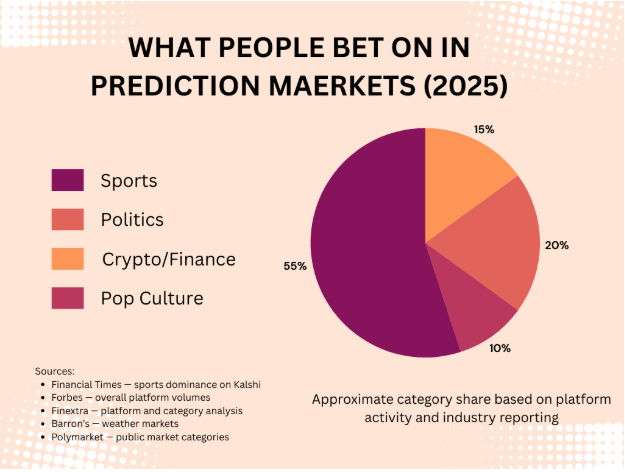
What people actually bet on
This is where prediction markets stopped feeling like finance and started feeling like the internet just being the internet.
Love, Actually: the Taylor Swift trade
One of the most talked-about markets of 2025 had nothing to do with economics or politics. It was about whether Taylor Swift and Travis Kelce would get engaged.
A Polymarket trader reportedly turned a $12,000 bet into more than $52,000 after the engagement was announced in August 2025. The odds swung wildly as rumors, paparazzi photos, and social media speculation poured in.
It was part celebrity gossip, part financial trade, and a perfect example of how prediction markets turn everyday curiosity into something you can buy and sell.
Weather became a market
In early 2026, Barron’s reported on traders buying and selling contracts tied to snowfall totals in New York City. And not just “Will it snow?”, but “How many inches will hit Central Park?”
Meteorologists, count your days. It’s not AI that’s coming for your job, just good old capitalism and the attention economy.
Pop culture, quantified
Polymarket now runs entire categories for pop culture predictions, including markets on awards shows, viral trends, and even baby names.
In 2025, users traded on whether names like Liam and Olivia would top national rankings, turning social trends into financial contracts. At this point, the difference between forecasting the future and gamifying curiosity is mostly a matter of perspective.
Sports without a sportsbook
If there’s one place where prediction markets truly went mainstream, it’s sports.
By late 2025, sports-related contracts accounted for the majority of trading volume on Kalshi, to the point that regulators and courts began treating the platform less as a financial exchange and more as an unlicensed sportsbook with a legal workaround.
According to Barron’s, Kalshi reported more than $200 million in trades tied to NCAA March Madness alone. The Financial Times later reported that sports markets account for as much as 90–95% of Kalshi’s fee revenue, underlining just how central sports have become to the platform’s business model.
Weekly and daily figures show just how concentrated trading has become around major sports and political events:
Volume Growth Over Time (Monthly/Weekly)
| Period | Volume |
|---|---|
| Weekly peak (Oct 2025) | $2.3 billion |
| Kalshi daily Jan 1, 2026 | $291 million |
| Kalshi daily Dec 1, 2025 | $147 million |
| Polymarket weekly (2026) | $786 million |
Big money, big questions
As prediction markets grew, so did scrutiny. Investopedia raised concerns about insider trading and market manipulation, particularly in markets tied to corporate decisions or political outcomes, where some participants may have access to non-public information.
Advocacy groups like Better Markets have been more direct, arguing that prediction markets are basically online casinos, not legitimate financial forecasting tools.
At the same time, supporters point to real-world examples where markets appeared to outperform polls or traditional forecasting, particularly in elections and macroeconomic events, reinforcing the idea that there’s something genuinely useful happening beneath the spectacle.
Somewhere between those two perspectives sits the average user, buying a contract about snowfall totals in New York City and wondering how checking the weather turned into a financial decision.
Platforms to know heading into 2026
According to Finextra, a few platforms stand out going into the new year:
- Polymarket: Crypto-native and global. Known for political, cultural, and viral markets, often where the most creative contracts appear first.
- Kalshi: US-regulated and legally embattled. The clearest example of how difficult it is to separate forecasting from betting when sports enter the picture.
- Manifold Markets: Community-driven and experimental. Less about high-stakes trading, more about collective curiosity.
Together, they represent three different futures: financial infrastructure, regulated exchange, and social prediction network.
So… what happens in 2026?
Plenty can happen in a year, but here are a few scenarios I can see potentially happening:
The bull case: going legit
In the optimistic version of the future, prediction markets become standard tools for analysts, journalists, and even companies.
Market odds start appearing next to polling data in news coverage. Businesses experiment with internal markets to forecast sales targets, product launches, and hiring needs. Researchers treat prediction prices as real-time sentiment indicators instead of relying solely on surveys.
And this isn’t purely hypothetical. Consulting firms like KPMG have already explored how prediction markets can be used for corporate forecasting and financial analysis, especially in environments where traditional models struggle to keep up with rapidly changing information.
In this world, platforms like Kalshi, which operate under US regulatory oversight, could become something closer to “Bloomberg Terminals for uncertainty,” offering structured, legally compliant access to event-based markets.
The middle path: big, but not everywhere
This is the most likely outcome. Prediction markets keep growing, but mainly among:
- Crypto traders
- Data analysts and forecasters
- Sports superfans
- Political and news junkies
They become culturally familiar without becoming essential. The numbers suggest this trajectory already. While overall trading volume surged past $40 billion in 2025, the majority of that activity clustered around a few high-interest categories like sports, politics, and major world events, rather than broad everyday use cases.
Platforms continue to expand, but adoption remains concentrated among users who already enjoy speculation, markets, or betting-adjacent experiences.
The bear case: the rulebook arrives
The biggest wildcard heading into 2026 is regulation. States have already begun pushing back on sports-related contracts, arguing that prediction markets are operating as unlicensed gambling platforms, not financial exchanges.
In early 2026, a Massachusetts judge ruled that Kalshi could not allow residents to trade on sports outcomes without proper gaming licenses. Other states, including Tennessee, issued cease-and-desist orders, forcing platforms to shut down sports markets or refund users entirely.
If this trend spreads, platforms may be forced to limit or remove the very categories that drive the most traffic and revenue, especially sports and pop culture. Without those markets, prediction platforms risk becoming too dry for mass audiences and too legally risky for institutions.
My take: the internet’s favorite thought experiment (with a price tag)
Prediction markets aren’t going away. The idea is too flexible and too well-matched to how the internet likes to interact with the future. They turn curiosity into contracts, opinions into assets, and collective attention into something you can buy and sell. That’s fascinating, occasionally useful, and more than a little surreal.
In 2026, I expect prediction markets to:
- Get more regulated, as states and federal agencies continue to test where forecasting ends, and gambling begins
- Get more sophisticated, with platforms improving liquidity, data tools, and market design to appeal to analysts and institutional users
- Get more embedded in media and finance, as odds and probabilities keep showing up alongside polls, forecasts, and breaking news
What they probably won’t do (yet) is replace your weather app, your favorite sports show, or your trusted news source.
Still, when people can trade on snowfall totals, celebrity engagements, and championship games in the same interface, one thing is clear: the future isn’t just predicted anymore, it’s priced.
Methodology
To write this article, we reviewed financial and industry reporting to track how prediction markets grew throughout 2025 and where trading activity has been most concentrated heading into 2026.
Trading volume figures and platform growth were compared across multiple business and crypto-focused publications to confirm trends rather than rely on a single data point. Legal and regulatory developments were followed to understand how different jurisdictions are responding to sports, political, and event-based markets.
To capture how prediction markets are actually being used, public markets on platforms like Polymarket and Manifold Markets were reviewed to identify high-volume, widely discussed, and unusual contracts across sports, weather, politics, and pop culture.
Outlook and projections for 2026 were developed by comparing recent platform expansion, shifts in market focus (such as the rise of sports-driven volume), and ongoing regulatory pressure, rather than making definitive claims about future performance.
Sources
- Front Office Sports: Prediction Markets Exploded in 2025
https://frontofficesports.com/prediction-markets-exploded-in-2025-what-comes-next/ - Forbes: How Prediction Markets Actually Grew in 2025
https://www.forbes.com/sites/boazsobrado/2025/12/16/how-prediction-markets-actually-grew-in-2025/ - Phemex News: Polymarket and Kalshi Achieve Record $40B Trading Volume in 2025
https://phemex.com/news/article/polymarket-and-kalshi-achieve-record-40b-trading-volume-in-2025-49434 - KPMG: The Current State of Prediction Markets
https://kpmg.com/us/en/articles/2025/current-state-of-prediction-markets.html - Finextra: Top Prediction Market Platforms to Watch in 2026
https://www.finextra.com/blogposting/30551/top-5-prediction-market-platforms-to-keep-an-eye-on-in-2026 - Reuters: Kalshi Cannot Operate Sports Prediction Market in Massachusetts, Judge Rules
https://www.reuters.com/world/kalshi-cannot-operate-sports-prediction-market-massachusetts-judge-rules-2026-01-20/ - Barron’s: Traders Are Betting on How Much Snow NYC Will Get
https://www.barrons.com/articles/nyc-snowfall-prediction-market-trading-54966649 - Financial Times: How Sports Became the Engine of Prediction Market Revenue
https://www.ft.com/content/1ac03f57-bd5d-4196-85ff-4bd96dc69e0d - Investopedia: As Prediction Markets Grow, Some Fear Insider Trading
https://www.investopedia.com/as-prediction-markets-grow-in-popularity-some-fear-insider-trading-what-s-next-11884669 - Better Markets: Prediction Markets Are Just Casinos
https://bettermarkets.org/analysis/predictably-prediction-markets-are-just-casinos/ - OnFinality: Understanding Prediction Markets
https://blog.onfinality.io/understanding-prediction-market/ - IndiaTimes: Polymarket Trader Wins $50,000 After Betting on Taylor Swift Engagement
https://indiatimes.com/trending/polymarket-trader-wins-50000-after-betting-on-taylor-swift-travis-kelce-engagement-in-2025-love-really-is-a-safe-bet-667973.html